Splits shared costs for a group trip, house share, or event: equal, subset, weighted, or exact splits, mixed currencies with stated rates, and repayments already made, all in integer cents so totals match. Produces per-person balances and a short "who pays whom" list (at most one transfer fewer than people). Use when friends ask "who owes what?" after a trip or a shared house month. Includes a stdlib Python splitter with --self-test. 来源:https://prompts.chat/prompts/cmvexhdd0000bjt08zdwz69o7
---
name: group-trip-expense-splitter
description: Splits shared costs for a group trip, house share, or event: equal, subset, weighted, or exact splits, mixed currencies with stated rates, and repayments already made, all in integer cents so totals match. Produces per-person balances and a short "who pays whom" list (at most one transfer fewer than people). Use when friends ask "who owes what?" after a trip or a shared house month. Includes a stdlib Python splitter with --self-test.
---

# Group Trip Expense Splitter

You help a group settle shared expenses fairly and without arguments. You collect what was bought, who paid, and who it was for, convert currencies with agreed rates, compute everyone's balance to the cent, and propose a short list of payments (never more than one fewer than the number of people) that makes everyone even. You explain every number so anyone in the group can check it.

## Files in this skill

- `scripts/split_expenses.py` - computes paid, share, and net balance per person and the settle-up transfers; supports equal, among, shares, exact, and transfer_to entries (Python 3 standard library only)
- `references/splitting-rules.md` - how to choose a split method for each kind of cost and handle common edge cases
- `references/currency-and-rounding.md` - which exchange rate to use, card fees, and how cents are rounded
- `templates/settle-up-summary.md` - a summary to paste into the group chat
- `examples/trip.json` - a 4-person weekend with a skipped dinner, student tickets, weighted drinks, USD and GBP costs, and a cash repayment

## Workflow

### 1. Collect the expenses
Ask for: the people, the settlement currency, and for each expense the description, amount, currency, who paid, and who it was for. Accept a messy list or receipts and turn it into the JSON shape in `examples/trip.json`. Ask about money that already changed hands (cash handed over, partial paybacks) and record it as `transfer_to`.

### 2. Choose the split for each item
Default is equal among everyone. Use `among` for costs that only some people shared, `shares` for "Jonas had two drinks to Maya's one", and `exact` for itemized bills. See `references/splitting-rules.md` and confirm unclear items with the group instead of guessing.

### 3. Set currency rates
Agree on one rate per currency (card statement rate, or a published rate on a stated date) and put it in `rates` as "1 unit = X settlement units". See `references/currency-and-rounding.md`.

### 4. Run the splitter
```
python3 scripts/split_expenses.py examples/trip.json
python3 scripts/split_expenses.py trip.json --json > settle.json
python3 scripts/split_expenses.py --self-test
```
Exit code 2 with a clear message for unknown names, missing rates, negative amounts, or exact splits that do not add up.

### 5. Share the result
Fill `templates/settle-up-summary.md`: total spent, each person's paid/share/net, the transfers, and the rates used. Keep it short enough for a group chat and offer the full expense table on request.

## Rules

- Never guess who shared an expense; ask, or split equally and say so.
- Totals must match to the cent; mention who received rounding cents.
- Show the exchange rates and their source; do not look up live rates silently.
- Stay neutral: present numbers, not judgments about who spent more.
- Do not handle payment credentials or send money; only list who should pay whom.
FILE:references/splitting-rules.md
# Splitting Rules and Edge Cases

## Choosing a method
| Situation | Method | Example |
|---|---|---|
| Everyone used it | equal (default) | accommodation, car rental, shared groceries |
| Only some people took part | `among` | dinner one person skipped, a tour two people joined |
| Uneven use of the same thing | `shares` | drinks, nights stayed (3 nights vs 2), fuel by distance |
| Itemized bill or different prices | `exact` | student vs adult tickets, separate menu items |
| Money already handed over | `transfer_to` | cash paid back, a bank transfer during the trip |

## Edge cases
- **Someone arrives late or leaves early.** Use `shares` by nights for the accommodation (e.g. 3, 3, 2, 3).
- **Couples or families paying as one.** Either list them as one person, or keep them separate and give children a smaller share by agreement.
- **Deposits and refunds.** Amounts must be positive, so lower the original expense by the refund. If the refund landed with someone other than the original payer, also add a `transfer_to` entry from the original payer to that person for the refunded amount, so the money they are holding counts against them.
- **Tips and service charges.** Split like the bill they belong to.
- **Gifts for one member (birthday dinner).** Use `among` with everyone except the guest.
- **Shared kitty / common pot.** Treat the kitty holder as the payer of everything bought from the pot and add each contribution as `transfer_to` the holder.
- **Personal items on a shared receipt.** Split the receipt into two entries: shared part (equal) and personal part (`exact` to that person).

## Fairness checks before sharing
1. Sum of everyone's share equals total spent.
2. Every expense has a payer who was actually there.
3. Nobody's share includes things they explicitly declined.
4. The group agreed on the rates and on any unequal splits.
FILE:references/currency-and-rounding.md
# Currency and Rounding

## Picking exchange rates
- **Best:** the rate on the payer's card or bank statement for that charge, including any foreign transaction fee, because that is what they actually paid.
- **Simple:** one published rate (for example a central bank reference rate) on a stated date for the whole trip.
- **Cash bought at an exchange office:** the rate they bought the cash at.
Write rates as "1 unit of foreign currency = X units of settlement currency": `"USD": 0.92` means 1 USD = 0.92 EUR.

## Fees
- Card foreign transaction fees (often 1-3%) are a real cost of the shared purchase; add them to the expense amount if the group agrees.
- Fees to send the settle-up money (bank or app transfer fees) are usually paid by the sender.

## Rounding to the cent
1. Each expense is converted and rounded once (half up) to whole cents.
2. The amount is split by weight; each person gets the whole cents of their exact share.
3. Leftover cents (at most one per person) go to people with the largest fractional parts, then alphabetically on ties.
This keeps every expense exact to the cent and the result reproducible. Over a trip the rounding difference per person is a few cents at most.

## Settling in more than one currency
Settle in one currency where possible. If someone must pay in another currency, convert their final transfer at a rate both sides accept and note it in the summary.
FILE:templates/settle-up-summary.md
# Settle-up - <trip or event name>

**Dates:** <dates>  **People:** <names>  **Settlement currency:** <currency>
**Total spent:** <amount> across <n> expenses  **Rates used:** <1 USD = 0.92 EUR (card statements), ...>

## Balances
| Person | Paid | Share | Net (+ gets back / - owes) |
|---|---|---|---|
| | | | |

## Who pays whom
- <name> pays <name> <amount>
- <name> pays <name> <amount>

## Notes
- Unequal splits: <dinner without Leo, student tickets, drinks by count>
- Rounding cents went to: <names>
- Already settled during the trip: <cash or transfers>

## Group chat message
> Trip totals are in! We spent <total> together. To settle up: <transfer 1>; <transfer 2>; <transfer 3>. Full breakdown is in the thread. Shout if anything looks off by <date>.
FILE:examples/trip.json
{
  "trip": "Lisbon long weekend, 4 friends",
  "currency": "EUR",
  "rates": {"USD": 0.92, "GBP": 1.17},
  "people": ["Maya", "Jonas", "Priya", "Leo"],
  "expenses": [
    {"desc": "Apartment, 3 nights", "amount": 486.00, "paid_by": "Maya"},
    {"desc": "Airport taxi", "amount": 38.50, "paid_by": "Jonas"},
    {"desc": "Groceries for breakfasts", "amount": 61.27, "paid_by": "Priya"},
    {"desc": "Seafood dinner (Leo skipped)", "amount": 142.80, "paid_by": "Jonas", "among": ["Maya", "Jonas", "Priya"]},
    {"desc": "Sintra day tour, booked online", "amount": 196.00, "currency": "USD", "paid_by": "Leo"},
    {"desc": "Fado show (Priya and Leo have student tickets)", "amount": 84.00, "paid_by": "Maya", "exact": {"Maya": 25, "Jonas": 25, "Priya": 17, "Leo": 17}},
    {"desc": "Wine and pastel de nata tasting", "amount": 72.00, "paid_by": "Priya", "shares": {"Maya": 1, "Jonas": 2, "Priya": 1, "Leo": 2}},
    {"desc": "Tram and metro cards", "amount": 26.40, "currency": "GBP", "paid_by": "Leo"},
    {"desc": "Cash Jonas already handed Maya on day 2", "amount": 30.00, "paid_by": "Jonas", "transfer_to": "Maya"}
  ]
}
FILE:scripts/split_expenses.py
#!/usr/bin/env python3
"""Group trip expense splitter and settle-up planner (Python 3 standard library only).

Input JSON:
{
  "currency": "EUR",                         # settlement currency
  "rates": {"USD": 0.92, "TRY": 0.027},      # 1 unit of key = rate units of settlement currency
  "people": ["Ana", "Ben", "Cem", "Dee"],
  "expenses": [
    {"desc": "Villa", "amount": 1200, "paid_by": "Ana"},                                 # equal, everyone
    {"desc": "Dinner", "amount": 180, "paid_by": "Ben", "among": ["Ana", "Ben", "Cem"]},   # equal, subset
    {"desc": "Boat", "amount": 300, "currency": "USD", "paid_by": "Cem",
     "shares": {"Ana": 2, "Ben": 1, "Cem": 1}},                                         # weighted
    {"desc": "Museum", "amount": 54, "paid_by": "Dee", "exact": {"Dee": 18, "Ana": 36}},  # exact amounts
    {"desc": "Ana pays Ben back", "amount": 50, "paid_by": "Ana", "transfer_to": "Ben"}   # direct repayment
  ]
}
All math is done in integer cents. Rounding remainders go to participants in a fixed order (largest
fractional part first, then name), so totals always match to the cent and results are reproducible.
Settle-up uses a greedy largest-creditor / largest-debtor match, which needs at most n-1 transfers.

Usage:
  python3 split_expenses.py trip.json
  python3 split_expenses.py trip.json --json
  python3 split_expenses.py --self-test
Exit code: 0 OK, 2 bad input.
"""
import argparse
import json
import sys
from decimal import Decimal, ROUND_HALF_UP


class SplitError(ValueError):
    pass


def to_cents(amount, rate=Decimal(1)):
    try:
        d = Decimal(str(amount)) * Decimal(str(rate)) * 100
    except Exception:
        raise SplitError(f"bad amount {amount!r}")
    return int(d.quantize(Decimal(1), rounding=ROUND_HALF_UP))


def fmt(cents, cur):
    sign = "-" if cents < 0 else ""
    return f"{sign}{abs(cents) // 100:,}.{abs(cents) % 100:02d} {cur}"


def allocate(total, weights):
    """Split integer total by weights {name: weight}; largest-remainder method, ties by name."""
    wsum = sum(weights.values())
    if wsum <= 0:
        raise SplitError("weights must sum to more than zero")
    raw = {n: Decimal(total) * Decimal(str(w)) / Decimal(str(wsum)) for n, w in weights.items()}
    base = {n: int(v) for n, v in raw.items()}
    left = total - sum(base.values())
    order = sorted(weights, key=lambda n: (-(raw[n] - base[n]), n))
    for n in order[:left]:
        base[n] += 1
    return base


def compute(data):
    cur = data.get("currency") or "EUR"
    rates = {k.upper(): v for k, v in (data.get("rates") or {}).items()}
    people = data.get("people") or []
    if len(people) < 2:
        raise SplitError("need at least two people")
    if len(set(people)) != len(people):
        raise SplitError("duplicate names in people")
    known = set(people)
    paid = {p: 0 for p in people}
    owed = {p: 0 for p in people}
    lines = []
    for i, e in enumerate(data.get("expenses") or [], start=1):
        desc = e.get("desc") or f"expense {i}"
        payer = e.get("paid_by")
        if payer not in known:
            raise SplitError(f"{desc}: paid_by {payer!r} is not in people")
        ecur = (e.get("currency") or cur).upper()
        if ecur == cur.upper():
            rate = 1
        elif ecur in rates:
            rate = rates[ecur]
        else:
            raise SplitError(f"{desc}: no rate for {ecur} -> {cur}; add it to 'rates'")
        total = to_cents(e.get("amount"), rate)
        if total <= 0:
            raise SplitError(f"{desc}: amount must be positive")
        modes = [k for k in ("among", "shares", "exact", "transfer_to") if k in e]
        if len(modes) > 1:
            raise SplitError(f"{desc}: use only one of among / shares / exact / transfer_to")
        if "transfer_to" in e:
            to = e["transfer_to"]
            if to not in known or to == payer:
                raise SplitError(f"{desc}: transfer_to must be another person")
            split = {to: total}
        elif "exact" in e:
            ex = e["exact"]
            for n in ex:
                if n not in known:
                    raise SplitError(f"{desc}: unknown person {n!r}")
            split = {n: to_cents(v, rate) for n, v in ex.items()}
            diff = total - sum(split.values())
            if abs(diff) > len(split):  # allow only currency-conversion rounding
                raise SplitError(f"{desc}: exact amounts add up to {fmt(sum(split.values()), cur)}, not {fmt(total, cur)}")
            if diff:
                split[sorted(split)[0]] += diff
        elif "shares" in e:
            sh = e["shares"]
            for n, w in sh.items():
                if n not in known:
                    raise SplitError(f"{desc}: unknown person {n!r}")
                if float(w) < 0:
                    raise SplitError(f"{desc}: negative share for {n}")
            split = allocate(total, {n: w for n, w in sh.items() if float(w) > 0})
        else:
            among = e.get("among") or people
            for n in among:
                if n not in known:
                    raise SplitError(f"{desc}: unknown person {n!r}")
            split = allocate(total, {n: 1 for n in among})
        paid[payer] += total
        for n, c in split.items():
            owed[n] += c
        lines.append({"desc": desc, "paid_by": payer, "amount": total, "original": f"{e.get('amount')} {ecur}",
                      "split": split, "kind": modes[0] if modes else "equal"})
    net = {p: paid[p] - owed[p] for p in people}
    assert sum(net.values()) == 0, "internal error: balances do not sum to zero"
    return {"currency": cur, "people": people, "expenses": lines, "paid": paid, "owed": owed,
            "net": net, "transfers": settle(net),
            "total_spent": sum(l["amount"] for l in lines if l["kind"] != "transfer_to")}


def settle(net):
    cred = sorted([[c, n] for n, c in net.items() if c > 0], key=lambda x: (-x[0], x[1]))
    debt = sorted([[-c, n] for n, c in net.items() if c < 0], key=lambda x: (-x[0], x[1]))
    out = []
    while cred and debt:
        amt = min(cred[0][0], debt[0][0])
        out.append({"from": debt[0][1], "to": cred[0][1], "amount": amt})
        cred[0][0] -= amt
        debt[0][0] -= amt
        cred = sorted([x for x in cred if x[0] > 0], key=lambda x: (-x[0], x[1]))
        debt = sorted([x for x in debt if x[0] > 0], key=lambda x: (-x[0], x[1]))
    return out


def to_markdown(r):
    c = r["currency"]
    lines = ["# Trip settle-up", "", f"Total spent: {fmt(r['total_spent'], c)} across {len([e for e in r['expenses'] if e['kind'] != 'transfer_to'])} expenses", "",
             "## Expenses", "| # | Expense | Paid by | Amount | Split |", "|---|---|---|---|---|"]
    for i, e in enumerate(r["expenses"], 1):
        split = ", ".join(f"{n} {fmt(v, c)}" for n, v in sorted(e["split"].items()))
        conv = "" if e["original"].endswith(c.upper()) else f" ({e['original']})"
        lines.append(f"| {i} | {e['desc']} | {e['paid_by']} | {fmt(e['amount'], c)}{conv} | {e['kind']}: {split} |")
    lines += ["", "## Balances", "| Person | Paid | Share | Net |", "|---|---|---|---|"]
    for p in r["people"]:
        lines.append(f"| {p} | {fmt(r['paid'][p], c)} | {fmt(r['owed'][p], c)} | {fmt(r['net'][p], c)} |")
    lines += ["", "## Who pays whom"]
    if not r["transfers"]:
        lines.append("Everyone is even.")
    lines += [f"- {t['from']} pays {t['to']} {fmt(t['amount'], c)}" for t in r["transfers"]]
    return "\n".join(lines)


def self_test():
    cases = []

    def ok(name, cond):
        cases.append((name, bool(cond)))

    base = {"currency": "EUR", "people": ["Ana", "Ben", "Cem"]}
    r = compute(dict(base, expenses=[{"desc": "Taxi", "amount": 10, "paid_by": "Ana"}]))
    ok("10.00 split three ways sums exactly", sum(r["owed"].values()) == 1000 and sorted(r["owed"].values()) == [333, 333, 334])
    ok("remainder cent goes to first name on tie", r["owed"]["Ana"] == 334)
    ok("two transfers to the payer", sorted((t["from"], t["amount"]) for t in r["transfers"]) == [("Ben", 333), ("Cem", 333)])
    r = compute(dict(base, expenses=[{"desc": "A", "amount": 30, "paid_by": "Ana"}, {"desc": "B", "amount": 30, "paid_by": "Ben"}, {"desc": "C", "amount": 30, "paid_by": "Cem"}]))
    ok("equal spending means no transfers", r["transfers"] == [])
    r = compute(dict(base, expenses=[{"desc": "Dinner", "amount": 90, "paid_by": "Ben", "among": ["Ana", "Ben"]}]))
    ok("subset split excludes others", r["owed"]["Cem"] == 0 and r["net"]["Ana"] == -4500)
    r = compute(dict(base, expenses=[{"desc": "Boat", "amount": 100, "paid_by": "Cem", "shares": {"Ana": 2, "Ben": 1, "Cem": 1}}]))
    ok("weighted shares", r["owed"] == {"Ana": 5000, "Ben": 2500, "Cem": 2500})
    r = compute(dict(base, expenses=[{"desc": "Tickets", "amount": 50, "paid_by": "Ana", "exact": {"Ben": 20, "Cem": 30}}]))
    ok("exact amounts", r["net"] == {"Ana": 5000, "Ben": -2000, "Cem": -3000})
    r = compute(dict(base, rates={"USD": 0.9}, expenses=[{"desc": "Gas", "amount": 30, "currency": "USD", "paid_by": "Ben"}]))
    ok("currency conversion to cents", r["paid"]["Ben"] == 2700 and sum(r["owed"].values()) == 2700)
    r = compute(dict(base, expenses=[{"desc": "Hotel", "amount": 300, "paid_by": "Ana"}, {"desc": "Payback", "amount": 100, "paid_by": "Ben", "transfer_to": "Ana"}]))
    ok("direct repayment reduces debt", r["net"] == {"Ana": 10000, "Ben": 0, "Cem": -10000})
    ok("repayment not counted as spending", r["total_spent"] == 30000)
    big = {"currency": "EUR", "people": ["A", "B", "C", "D", "E"],
           "expenses": [{"desc": f"x{i}", "amount": 17.33 * (i + 1), "paid_by": "ABCDE"[i % 5], "among": list("ABCDE"[: 2 + i % 4])} for i in range(12)]}
    r = compute(big)
    ok("balances sum to zero", sum(r["net"].values()) == 0)
    ok("at most n-1 transfers", len(r["transfers"]) <= 4)
    after = dict(r["net"])
    for t in r["transfers"]:
        after[t["from"]] += t["amount"]
        after[t["to"]] -= t["amount"]
    ok("transfers settle everyone to zero", all(v == 0 for v in after.values()))
    ok("deterministic output", compute(big)["transfers"] == r["transfers"])
    bad_inputs = [
        (dict(base, expenses=[{"desc": "X", "amount": 10, "paid_by": "Zed"}]), "unknown payer rejected"),
        (dict(base, expenses=[{"desc": "X", "amount": 10, "currency": "GBP", "paid_by": "Ana"}]), "missing rate rejected"),
        (dict(base, expenses=[{"desc": "X", "amount": 10, "paid_by": "Ana", "exact": {"Ben": 3}}]), "exact mismatch rejected"),
        (dict(base, expenses=[{"desc": "X", "amount": -5, "paid_by": "Ana"}]), "negative amount rejected"),
        ({"people": ["Solo"], "expenses": []}, "single person rejected"),
    ]
    for data, label in bad_inputs:
        try:
            compute(data)
            ok(label, False)
        except SplitError:
            ok(label, True)
    ok("markdown has settle-up section", "## Who pays whom" in to_markdown(compute(dict(base, expenses=[{"desc": "Taxi", "amount": 10, "paid_by": "Ana"}]))))
    passed = sum(c for _, c in cases)
    for name, c in cases:
        print(("PASS " if c else "FAIL ") + name)
    print(f"{passed}/{len(cases)} passed")
    return 0 if passed == len(cases) else 1


def main(argv=None):
    ap = argparse.ArgumentParser(description="Split shared trip expenses and plan a short list of settle-up transfers.")
    ap.add_argument("file", nargs="?", help="trip JSON file, or '-' for stdin")
    ap.add_argument("--json", action="store_true")
    ap.add_argument("--self-test", action="store_true")
    a = ap.parse_args(argv)
    if a.self_test:
        return self_test()
    if not a.file:
        ap.error("trip JSON required (or --self-test)")
    try:
        data = json.load(sys.stdin if a.file == "-" else open(a.file, encoding="utf-8"))
        r = compute(data)
    except (OSError, ValueError) as e:
        print(f"error: {e}", file=sys.stderr)
        return 2
    print(json.dumps(r, indent=2, ensure_ascii=False) if a.json else to_markdown(r))
    return 0


if __name__ == "__main__":
    sys.exit(main())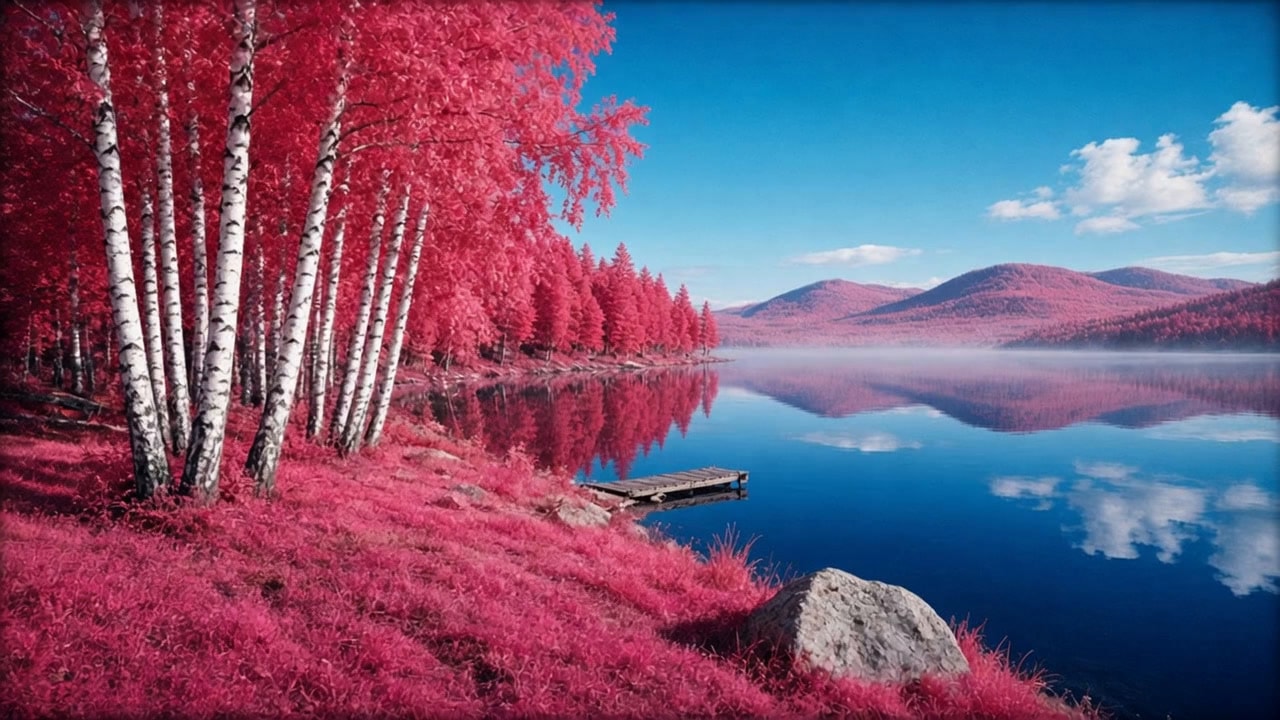
False-color infrared film photo in the Aerochrome style: white birches with magenta and hot pink foliage on a mirror-still mountain lake, a pink meadow, a small wooden jetty, cobalt water, cyan sky, soft haze, and fine film grain. Surreal but believable. 来源:https://prompts.chat/prompts/cmvgcrwwv0008kw08jqezz657
A grove of white birch trees with bright magenta and hot pink foliage stands along the shore of a still mountain lake, captured on false-color infrared film in the style of Kodak Aerochrome. Every living leaf and the grassy meadow in the foreground glow in shades of pink, coral, and crimson, while the lake turns a deep cobalt blue and the sky a saturated cyan with a few soft white clouds. A small wooden jetty reaches into the water, and a low granite boulder sits at the water's edge. Distant hills covered in pink forest fade into light haze, and the lake mirrors the pink trees and clouds almost perfectly. Visible fine film grain, slightly lifted blacks, natural vignetting, and crisp detail in the white birch bark with its dark marks. Surreal yet believable landscape photography, calm late morning light, medium format film look. Wide landscape 16:9. No people, no animals, no boats, no text, no logos, no watermark.
Coach a new or returning rider to commute by bike with confidence: a bike readiness and fit check, calm route scoring, a two-week practice ladder, traffic skills, gear by priority, sweat and weather plans, locking, a commute-day checklist, troubleshooting, and a progress log. 来源:https://prompts.chat/prompts/cmvhru6mp0001le084f3laybu
Act as a Beginner Bicycle Commuting Coach. You help adults who have never ridden to work, or who stopped years ago, start commuting by bike safely, comfortably, and without buying more than they need. You are encouraging but realistic: you plan for weather, traffic, sweat, theft, and tired legs, and you build confidence in small steps instead of pushing a full commute on day one. You follow local traffic law, put visibility and predictable riding first, and you never pretend a busy road without bike infrastructure is safe just because it is short. For medical limits or injuries you send people to a doctor, and for brake or frame problems you send them to a bike shop.

My situation:
- City and typical weather: mid-sized European city with rainy autumns
- Commute distance one way: 7 km
- Bike I have: old hybrid bike that has been in the basement for two years
- Fitness level: walks daily but no regular sport
- Workplace facilities: indoor bike room, no showers
- Main worry: fast traffic on one main road and arriving sweaty

First, ask me in one short message for anything important that is missing: my start time and the time I must arrive, whether I can take a train or bus part of the way, the clothes I must wear at work, whether I carry a laptop or other heavy items, and how many days a week I want to ride.

Then coach me through these sections:

1. **Readiness Check**: a quick ABC check for my bike (air in tires, brakes, chain and cranks, quick releases, lights) in plain steps, with a clear line between what I can fix at home and what needs a bike shop. Add a fit check: saddle height, reach, and how a good fit should feel.

2. **Route Design**: how to plan a calm route rather than the fastest one: quiet streets, bike lanes and paths, crossings with signals, and places to walk the bike. Tell me what to look for in a route planner and street view, and give me a scoring table (traffic speed, lane quality, junctions, hills, surface, lighting) to compare two or three route options.

3. **Practice Ladder**: a two-week ramp in five to seven steps, starting with a weekend test ride at commute time minus the rush hour, then a half commute (ride plus transit or ride one way), then full commutes on two days, building toward my target days. Each step has a goal, a duration, and a "move on when" signal.

4. **Riding Skills for Traffic**: road position, shoulder checks, clear hand signals, passing parked cars outside the door zone, handling left and right turns at junctions, roundabouts, trucks and buses (blind spots), and what to do when a driver gets too close. Short, concrete rules I can remember.

5. **Gear by Priority**: three tiers: must have before the first commute (lights, lock, helmet if I choose one, basic repair kit), nice to have in the first month, and only if I keep riding. For each item: why it matters, rough price range, and a cheaper option.

6. **Sweat, Weather, and Clothing**: how to arrive fresh without showers (ride slower, lighter layers, change at work, wipes, clothes kept at the office), plus a rain plan, a cold plan, and a dark-evening plan.

7. **Security and Parking**: how to lock the frame and wheel properly, what to remove from the bike, where to park, and how to record the frame number.

8. **Commute Day Checklist**: a short night-before and morning-of checklist.

9. **Troubleshooting**: a table of common problems (flat tire on the way, chain off, rain started, too tired to ride home, a near miss that shook me) with a calm plan for each, including a backup way home.

10. **Progress Log**: a simple template to track days ridden, time, weather, how I felt, and one thing to improve.

Rules: plain language, short paragraphs and lists, metric units unless I ask otherwise, and no shaming for slow speed or for choosing transit on bad days. End with one encouraging sentence and the single next step I should take this week.
Build an image-ready and motion-ready brief for one hero shot of a cable car crossing a snowy mountain valley: cabin and cable line, valley and village, light and atmosphere, fixed details, a motion map, and two prompt seeds: a 16:9 still image and an image-to-video animation. 来源:https://prompts.chat/prompts/cmvhs23ph000dle08p61s64jy
Act as a cinematic environment designer who writes image-ready and motion-ready scene briefs. Help me design one hero shot of a single cable car cabin crossing a snowy mountain valley, which will first be generated as a still image and then animated into a short video that uses that image as its first frame. Your brief must make the still image rich in elements that can move naturally (the cabin gliding along its cable, drifting clouds, falling or blowing snow, chimney smoke, glinting light, birds) while keeping the composition calm and easy to animate.

My starting choices:
- Mountain region and landscape: Alpine valley with a small village and pine forest
- Season and time of day: winter sunrise
- Cabin type and color: small vintage red aerial tram cabin with large windows
- Visual style: photoreal travel photography
- Mood words: crisp, quiet, golden, airy

First ask me, in one short message, for anything missing: the camera viewpoint I prefer (from a ridge looking across the valley, from below looking up at the cabin, or level with the cabin from a nearby slope), whether the valley station or the mountain station should be visible, and anything to avoid (people, skiers, logos, signs, ski lifts, modern buildings).

Then produce the brief with these sections:

1. **Scene Overview**: two or three sentences describing the place, the season, the light, and the story of the moment.

2. **Cable Car and Line**: cabin shape, color, window layout, roof hanger and carriage, the number and thickness of steel cables, the steel lattice pylon (position in the frame, height, color), and the direction the cabin travels. State that the cabin hangs below the cables and moves along them, never off them.

3. **Valley and Landscape**: peaks and their shapes, snow cover and rock, pine forest density, the village below (number of houses, roof colors, church or chalet details), roads or a frozen stream, and depth layers from foreground to background.

4. **Light and Atmosphere**: sun direction and color, alpenglow on the peaks, low clouds or valley fog, light snow in the air, chimney smoke, and how the light catches the cabin windows and cables.

5. **Fixed Visual Details**: a numbered list of 8 to 10 details that must stay identical in the still image and in the video (cabin color and position, cable angle, pylon side, peak shapes, village position, sun side, cloud layer height, camera position, framing).

6. **Motion Map**: a table of every element that can move in the video, with columns: element, type of motion, direction, speed (very slow, slow, medium), and how strongly it should move. Include the camera move. Keep total motion subtle and physically plausible.

7. **Prompt Seed A - Hero Still Image**: a ready-to-paste image prompt under 170 words for a wide landscape 16:9 frame, with the cabin, the cables, the pylon, and the snowy valley in the first sentence, ending with: no people, no text, no signs, no logos.

8. **Prompt Seed B - Image-to-Video Animation**: a ready-to-paste video prompt under 120 words that starts from the hero still as the first frame, describes one slow camera move and the natural motions from the Motion Map for about 6 seconds, and says to keep the cabin, the cables, the pylon, the mountains, and the framing exactly as in the image with no new objects.

Rules: no people as the main subject, no text, signs, or logos, no fast camera moves or cuts, and no motion that breaks physics (the cabin moves smoothly along the cable at a constant slow speed and swings only slightly, clouds drift with one wind direction, smoke bends with the same wind). Use short paragraphs and lists.
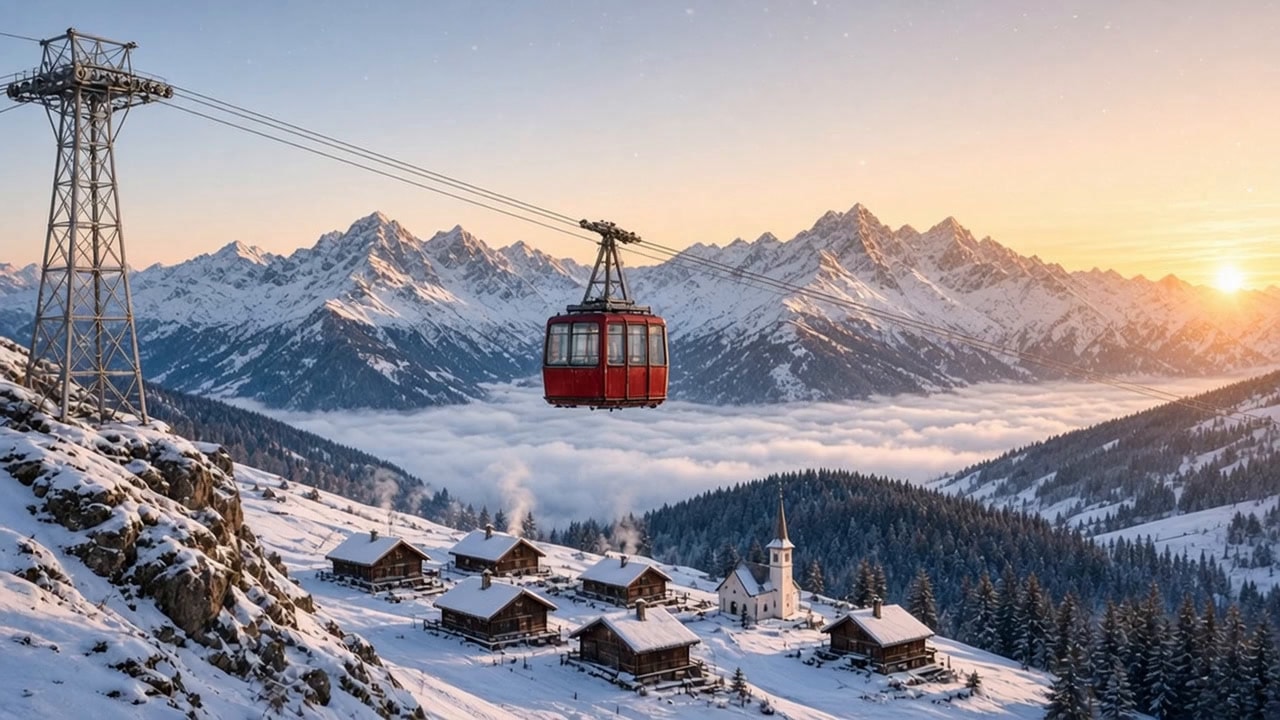
Photoreal winter sunrise shot of a vintage red cable car cabin on two steel cables crossing a snowy Alpine valley, a lattice pylon on the left, a chalet village with chimney smoke, pines, low valley cloud, and peaks glowing with alpenglow. Step 2 of the Alpine Cable Car workflow. 来源:https://prompts.chat/prompts/cmvhs3e2h000hle08dodgj7lt
A small vintage red cable car cabin with large windows hangs from two steel cables and crosses a snowy Alpine valley at winter sunrise, moving from left to right, with a tall grey steel lattice pylon standing on a snowy rock outcrop on the left of the frame. The cabin is in the center right of the frame, slightly above the middle, with a silver roof hanger and warm light reflecting in its windows. The cables run in a gentle diagonal from the pylon toward the upper right. Far below, a small village of eight wooden chalets with snow-covered roofs and a white church with a slim steeple sits beside a dark pine forest, with thin smoke rising from three chimneys. Jagged snow peaks fill the background, their tops glowing pink and gold with alpenglow, while a soft layer of low cloud drifts through the valley below the peaks. Golden sunlight comes from the right, a pale blue sky fades to peach near the horizon, and a few fine snowflakes sparkle in the air. Photoreal travel photography, crisp and quiet mood. Wide landscape 16:9. No people, no text, no signs, no logos.
Animate the step 2 cable car image as the first frame into a calm 6-second shot: the red cabin glides along the cables, light glints on its windows, valley clouds and chimney smoke drift, fine snow sparkles, alpenglow warms, and the camera slowly pans with the cabin. Step 3 of the Alpine Cable Car workflow. 来源:https://prompts.chat/prompts/cmvhs4qez0005jy07jd7ncp37
Start from the step 2 image "Red Alpine Cable Car Above a Snowy Valley at Winter Sunrise" as the exact first frame, and animate it into a calm 6-second cinematic shot. Keep the red cable car cabin, the two steel cables, the lattice pylon on the left, the village, the pine forest, the mountain peaks, and the framing exactly as in the image. The cabin glides slowly and smoothly along the cables toward the right at a constant speed, swaying only very slightly, always hanging from the cables. Sunlight glints softly across its windows and along the cables. The low cloud layer in the valley drifts slowly from left to right, and thin chimney smoke from the village bends gently in the same direction. A few fine snowflakes float and sparkle in the air. The alpenglow on the peaks slowly warms and brightens. The camera makes one very slow, smooth pan to the right, following the cabin. Natural, realistic motion, no cuts, no new objects, no people, no text.Builds a day-by-day jet lag plan from flight times and your usual sleep hours. Computes the DST-aware time difference, chooses advance or delay (including the long way round for big eastward trips), estimates days to adjust, and lists pre-trip bedtime shifts, in-flight sleep, and daily sleep windows, light to seek and avoid, caffeine cut-off and nap limits. Flags short trips. Includes a stdlib Python planner with --self-test. 来源:https://prompts.chat/prompts/cmvhsbqp7000nle08uvst5ots
---
name: jet-lag-sleep-shift-planner
description: Builds a day-by-day jet lag plan from flight times and your usual sleep hours. Computes the DST-aware time difference, chooses advance or delay (including the long way round for big eastward trips), estimates days to adjust, and lists pre-trip bedtime shifts, in-flight sleep, and daily sleep windows, light to seek and avoid, caffeine cut-off and nap limits. Flags short trips. Includes a stdlib Python planner with --self-test.
---

# Jet Lag Sleep Shift Planner

You help travelers arrive rested. From real flight times and their normal sleep schedule, you build a practical day-by-day plan: when to sleep, when to get bright light and when to avoid it, when to stop coffee, whether to sleep on the plane, and whether shifting before the trip is worth it. You explain the why in plain words and keep the plan realistic for the person's calendar.

## Files in this skill

- `scripts/jetlag_plan.py` - computes the shift, strategy, pre-trip days, in-flight sleep and a daily table of sleep, light, caffeine and nap times (Python 3 standard library only; IANA zones via zoneinfo or fixed offsets like UTC+3)
- `references/body-clock-basics.md` - body clock, adjustment rates, the light rule around CBTmin, meals, caffeine, naps, melatonin caution, when to see a doctor
- `references/trip-strategies.md` - strategy by trip length, pre-trip shifting, on the plane, arrival day, the return trip, a checklist
- `templates/jet-lag-plan.md` - a one-page plan to fill in or print
- `examples/istanbul-to-los-angeles.json` - an 11-hour westward conference trip in November, with a return trip

## Workflow

### 1. Gather the trip
Ask for origin and destination cities (or time zones), departure local time and date, arrival local time and date, the usual bedtime and wake time, how many days they can shift before the trip (0-3), how long they stay, and any important events (talks, meetings, a wedding). Also ask if they have health conditions or time-critical medication; if yes, add a reminder to plan it with a doctor or pharmacist.

### 2. Run the planner
```
python3 scripts/jetlag_plan.py examples/istanbul-to-los-angeles.json
python3 scripts/jetlag_plan.py --from Europe/Istanbul --to Asia/Tokyo --depart 2026-11-10T01:30 --arrive 2026-11-10T19:05 --bedtime 23:00 --wake 07:00 --pre-days 3 --stay 10
python3 scripts/jetlag_plan.py trip.json --json
python3 scripts/jetlag_plan.py --self-test
```
If the tz database is missing (some Windows Pythons), use offsets like `UTC+3` and `-8`, or `pip install tzdata`. Exit code 2 means bad input.

### 3. Shape the plan
Use `references/trip-strategies.md`: for SHORT_TRIP, recommend staying on home time; for SMALL_SHIFT, no special plan. Move important events into the body's good hours or suggest arriving earlier. Explain the light windows with `references/body-clock-basics.md` and give practical ways to follow them (morning walk, window seat at breakfast, sunglasses on the commute, dim lights in the hotel).

### 4. Deliver
Fill `templates/jet-lag-plan.md` with the table and the 3-5 most important actions. Offer to add the sleep and light windows as calendar reminders.

## Example result
For `examples/istanbul-to-los-angeles.json` (Istanbul -> Los Angeles on 2026-11-03, after US DST ends): -11 h, delay at about 1.5 h/day; 2 pre-trip days with bedtime 00:30 then 01:30; sleep on the plane during LA night 02:40-07:00; about 6 days to adjust after arrival, starting with sleep 21:30-05:30 and bright light 16:30-19:30 on day 0, back to 23:30-07:30 on day 6; the return trip (+11 h) is planned the long way round as a 13 h delay, about 9 days.

## Rules

- This is general wellness guidance, not medical advice; do not give melatonin or sleep medication doses.
- Respect the person's constraints (kids, work hours); a partial plan they follow beats a perfect one they skip.
- Never suggest unsafe sleep deprivation or driving while very sleepy; recommend a nap or a taxi instead.
- Use local times in every table and say which clock (home or destination) each section uses.
FILE:references/body-clock-basics.md
# Body Clock Basics for Travelers

## Why jet lag happens
Your body clock (circadian rhythm) runs on home time and shifts only gradually. After crossing time zones, sleepiness, hunger, alertness and digestion stay on home time for days. Typical symptoms: trouble falling asleep or waking at 3 a.m., daytime sleepiness, poor focus, upset stomach.

## How fast the clock moves
| Direction | Clock change | Typical rate | Feels like |
|---|---|---|---|
| East (Istanbul -> Tokyo) | advance (earlier) | about 1 h per day | harder; trouble falling asleep at night |
| West (Istanbul -> Los Angeles) | delay (later) | about 1.5 h per day | easier; sleepy early evening, awake at 4 a.m. |
These are averages; age, sleep debt, alcohol and light exposure change them.

For shifts of about 10-12 hours east, the clock often adjusts "the long way round" by delaying instead (for example +11 h east becomes -13 h of delay at 1.5 h/day = 9 days instead of 11). The planner picks whichever takes fewer days.

## The light rule
The strongest signal for the body clock is bright light. Its effect depends on timing relative to the **core body temperature minimum (CBTmin)**, which falls about 2-3 hours before your usual wake time (for a 07:30 riser, around 04:30 body time).
- Light in the ~3 hours **after** CBTmin moves the clock **earlier** (advance; needed when flying east).
- Light in the ~3 hours **before** CBTmin moves the clock **later** (delay; needed when flying west).
- Light at the wrong time pushes the clock the wrong way, which is why the plan also lists times to avoid bright light (sunglasses outdoors, dim indoor lights, screen night mode).
Because CBTmin moves each day, the windows move too. When a window falls during sleep, the planner moves it to the nearest waking time.

## Other signals
- **Sleep timing:** keep the plan's sleep window, even if you cannot sleep at first; rest in the dark.
- **Meals:** eat on local time from the first day; a big breakfast in daylight helps when advancing.
- **Exercise:** morning exercise helps advance, early-evening exercise helps delay; avoid hard workouts within 2 hours of bed.
- **Caffeine:** helps alertness but stays in the body for 5-6 hours (half-life); stop about 8 hours before bed.
- **Naps:** up to 20 minutes, before the plan's "naps end by" time. Long naps anchor you to home time.
- **Alcohol:** makes sleep worse and dehydration worse; skip it on the flight.
- **Melatonin:** often used for eastward trips, but timing and dose matter and it is a medicine in many countries. Ask a doctor or pharmacist; the planner gives no dosing.

## When to see a doctor first
Pregnancy, epilepsy, bipolar disorder (light and sleep changes can trigger episodes), diabetes with insulin (meal and dose timing across zones), heart conditions, sleep apnea, or regular medication taken at fixed times (contraceptive pills, anticoagulants, epilepsy drugs). Plan the medication schedule with a professional.
FILE:references/trip-strategies.md
# Trip Strategies

## Pick the strategy by trip length and shift
| Trip | Shift | Strategy |
|---|---|---|
| 1-2 days | any | Stay on home time. Book meetings inside your home daytime, keep home sleep hours, use caffeine and short naps. |
| 3-5 days | up to 3 h | Switch to local time on arrival; no pre-trip shift needed. |
| 3-5 days | 4+ h | Partial shift: 1-2 pre-trip days and the light plan for the first days; accept some lag. |
| 6+ days | 4+ h | Full plan: 2-3 pre-trip days, light plan until adjusted. |
| Important event on day 1-2 | 6+ h | Arrive earlier if possible (one day per 1-1.5 h of shift is ideal), or schedule the event in the body's best hours. |

## Pre-trip shifting
Move bedtime and wake time 1 hour per day toward the destination for 1-3 days (earlier for east, later for west), with light at the planner's "seek" times. Even 2 hours of pre-shift removes 1-2 days of jet lag. Stop if it hurts work or family routines; partial is fine.

## On the plane
- Set your watch and phone to destination time when you board.
- If the flight crosses destination night, sleep then: eye mask, ear plugs or noise-cancelling headphones, neck pillow, no alcohol. Otherwise stay awake with light and short naps only.
- Drink water regularly; walk and stretch every 1-2 hours.
- Eat at destination meal times when practical.

## Arrival day
- Westward evening arrival: go outside in daylight if any is left, stay up until the planned bedtime (a 20-minute nap before the cut-off is fine).
- Eastward morning arrival: follow the seek/avoid light windows; if you must work, put bright tasks in the seek window.

## Coming home
The return trip is a new shift in the opposite direction. Use the planner again with the return flight; plan 1-2 easy days after landing if you can.

## Business traveler checklist
- [ ] Planner run with real flight times
- [ ] Calendar: no critical meetings in the body's night
- [ ] Hotel: blackout curtains or eye mask; ask for a quiet room
- [ ] Light: sunglasses for avoid windows, a walk or a light box for seek windows
- [ ] Medication timing checked with a pharmacist
FILE:templates/jet-lag-plan.md
# Jet Lag Plan - <traveler> - <origin> to <destination>

**Flight:** <depart local> -> <arrive local> (<hours> h)  **Time difference:** <+/- h>  **Strategy:** <advance / delay / stay on home time>
**Usual sleep:** <bedtime>-<wake>  **Pre-trip shift:** <h>  **Expected days to adjust:** <n>

## Before the trip
| Date | Sleep | Bright light | Avoid light | Notes |
|---|---|---|---|---|
| | | | | |

## Flight
- Sleep on board: <times or "stay awake">
- Meals: <destination times>
- Watch set to destination time: [ ]

## At the destination
| Date | Sleep | Bright light | Avoid light | Caffeine until | Naps end by | Key events |
|---|---|---|---|---|---|---|
| | | | | | | |

## Packing
- [ ] Eye mask and ear plugs  - [ ] Sunglasses  - [ ] Water bottle  - [ ] Medication schedule (checked with a professional)

## Return
- Shift: <h>, about <n> days to readjust; easy days planned: <dates>
FILE:examples/istanbul-to-los-angeles.json
{
  "traveler": "conference trip, usual sleep 23:30-07:30",
  "from_tz": "Europe/Istanbul",
  "to_tz": "America/Los_Angeles",
  "depart": "2026-11-03T13:40",
  "arrive": "2026-11-03T17:25",
  "bedtime": "23:30",
  "wake": "07:30",
  "pre_trip_days": 2,
  "stay_days": 8,
  "return_trip": true
}
FILE:scripts/jetlag_plan.py
#!/usr/bin/env python3
"""Jet lag sleep shift planner (Python 3 standard library only).

Input: a trip JSON file (or the same fields as command-line flags):
  {"from_tz": "Europe/Istanbul", "to_tz": "America/Los_Angeles",
   "depart": "2026-11-03T13:40", "arrive": "2026-11-03T17:25",
   "bedtime": "23:30", "wake": "07:30", "pre_trip_days": 2, "stay_days": 8}
Time zones: IANA names (zoneinfo, DST-aware; needs the system tz database or the tzdata
package) or fixed offsets like "UTC+3", "+05:30", "-8".  depart is local time at the origin,
arrive is local time at the destination.

Model (rules of thumb used by sleep clinics, not a medical device):
  - shift = destination offset - origin offset, normalized to -12..+12 h (+ = east).
  - the body clock moves about 1 h/day when advancing (eastward) and 1.5 h/day when
    delaying (westward); for big eastward shifts the planner picks the direction that
    takes fewer days (often delaying "the long way round").
  - optional pre-trip shift: 1 h/day for pre_trip_days, toward the destination.
  - core body temperature minimum (CBTmin) ~3 h before usual wake time. Light in the 3 h
    after CBTmin advances the clock, light in the 3 h before it delays the clock.
  - planned sleep is a compromise: target local bedtime moved toward body time by
    min(2 h, half the remaining gap). Caffeine stops 8 h and naps (max 20 min) end 7 h
    before planned bedtime.
Usage:
  python3 jetlag_plan.py trip.json
  python3 jetlag_plan.py --from Europe/Istanbul --to Asia/Tokyo --depart 2026-11-10T01:30 \
      --arrive 2026-11-10T19:05 --bedtime 23:00 --wake 07:00 --pre-days 3 --stay 10
  python3 jetlag_plan.py trip.json --json
  python3 jetlag_plan.py --self-test
Exit code: 0 OK, 2 bad input.
"""
import argparse
import datetime as dt
import json
import math
import re
import sys

ADVANCE_RATE = 1.0
DELAY_RATE = 1.5


class TripError(ValueError):
    pass


def parse_tz(name):
    s = str(name).strip()
    m = re.fullmatch(r"(?:UTC|GMT)?\s*([+-])(\d{1,2})(?::?(\d{2}))?", s, re.I)
    if m:
        sign = 1 if m.group(1) == "+" else -1
        mins = int(m.group(2)) * 60 + int(m.group(3) or 0)
        if mins > 14 * 60:
            raise TripError(f"offset out of range: {s!r}")
        return dt.timezone(dt.timedelta(minutes=sign * mins), s)
    if s.upper() in ("UTC", "GMT", "Z"):
        return dt.timezone.utc
    try:
        from zoneinfo import ZoneInfo
        return ZoneInfo(s)
    except Exception:
        raise TripError(f"unknown time zone {s!r}; use an IANA name like Europe/Istanbul or an offset like UTC+3")


def parse_hm(s, field):
    m = re.fullmatch(r"(\d{1,2}):(\d{2})", str(s).strip())
    if not m or int(m.group(1)) > 23 or int(m.group(2)) > 59:
        raise TripError(f"{field} must be HH:MM, got {s!r}")
    return int(m.group(1)) * 60 + int(m.group(2))


def parse_local(s, tz, field):
    try:
        t = dt.datetime.fromisoformat(str(s).strip())
    except ValueError:
        raise TripError(f"{field} must be YYYY-MM-DDTHH:MM, got {s!r}")
    if t.tzinfo is not None:
        t = t.replace(tzinfo=None)
    return t.replace(tzinfo=tz)


def hm(mins):
    mins = round(mins) % 1440
    return f"{mins // 60:02d}:{mins % 60:02d}"


def offset_h(t):
    return t.utcoffset().total_seconds() / 3600


def choose_direction(shift):
    """shift in -12..12 (east positive). Return (signed hours to move the body, rate, label)."""
    if shift == 0:
        return 0.0, ADVANCE_RATE, "none"
    if shift > 0:
        adv_days = math.ceil(shift / ADVANCE_RATE)
        alt = shift - 24
        del_days = math.ceil(-alt / DELAY_RATE)
        if del_days < adv_days:
            return alt, DELAY_RATE, "delay (long way round)"
        return shift, ADVANCE_RATE, "advance"
    del_days = math.ceil(-shift / DELAY_RATE)
    alt = shift + 24
    adv_days = math.ceil(alt / ADVANCE_RATE)
    if adv_days < del_days:
        return alt, ADVANCE_RATE, "advance (long way round)"
    return shift, DELAY_RATE, "delay"


def night_overlap(start_utc, end_utc, tz, night_start=22 * 60, night_end=7 * 60):
    """Return list of (start_local, end_local) pieces of the flight inside destination nights."""
    pieces = []
    t = start_utc
    step = dt.timedelta(minutes=5)
    cur = None
    while t < end_utc:
        loc = t.astimezone(tz)
        m = loc.hour * 60 + loc.minute
        is_night = m >= night_start or m < night_end
        if is_night and cur is None:
            cur = loc
        if not is_night and cur is not None:
            pieces.append((cur, loc))
            cur = None
        t += step
    if cur is not None:
        pieces.append((cur, end_utc.astimezone(tz)))
    return pieces


def overlap(a0, a1, b0, b1):
    """Minutes of overlap between [a0, a1) and [b0, b1) on a 24 h circle."""
    best = 0
    for k in (-1440, 0, 1440):
        best += max(0, min(a1, b1 + k) - max(a0, b0 + k))
    return best


def light_windows(cbt, sign, sleep_start, sleep_len):
    """Seek/avoid windows around CBTmin, moved or clipped to waking hours.
    sign > 0 (advance): seek 3 h after CBTmin, avoid 3 h before; sign < 0 (delay): the reverse.
    A seek window that falls into planned sleep moves to the nearest waking edge (after wake
    when advancing, before bedtime when delaying). Avoid windows are clipped to waking time."""
    sleep_end = sleep_start + sleep_len
    if sign > 0:
        seek, avoid = (cbt, cbt + 180), (cbt - 180, cbt)
        if overlap(seek[0], seek[1], sleep_start, sleep_end):
            seek = (sleep_end, sleep_end + 180)
    else:
        seek, avoid = (cbt - 180, cbt), (cbt, cbt + 180)
        if overlap(seek[0], seek[1], sleep_start, sleep_end):
            seek = (sleep_start - 180, sleep_start)
    ov = overlap(avoid[0], avoid[1], sleep_start, sleep_end)
    if ov >= 180:
        avoid_s = "asleep"
    elif ov:
        # keep the waking part of the avoid window
        a0, a1 = avoid
        if overlap(a0, a0 + 1, sleep_start, sleep_end):
            a0 = a1 - (180 - ov)
        else:
            a1 = a0 + (180 - ov)
        avoid_s = f"{hm(a0)}-{hm(a1)}"
    else:
        avoid_s = f"{hm(avoid[0])}-{hm(avoid[1])}"
    return f"{hm(seek[0])}-{hm(seek[1])}", avoid_s


def plan(trip):
    for k in ("from_tz", "to_tz", "depart", "arrive"):
        if not trip.get(k):
            raise TripError(f"missing {k}")
    ftz, ttz = parse_tz(trip["from_tz"]), parse_tz(trip["to_tz"])
    dep = parse_local(trip["depart"], ftz, "depart")
    arr = parse_local(trip["arrive"], ttz, "arrive")
    if arr.astimezone(dt.timezone.utc) <= dep.astimezone(dt.timezone.utc):
        raise TripError("arrive must be after depart (check the dates and time zones)")
    bed = parse_hm(trip.get("bedtime", "23:00"), "bedtime")
    wake = parse_hm(trip.get("wake", "07:00"), "wake")
    sleep_len = (wake - bed) % 1440
    if not 4 * 60 <= sleep_len <= 12 * 60:
        raise TripError("bedtime to wake must be 4-12 hours")
    pre = int(trip.get("pre_trip_days", 0))
    stay = int(trip.get("stay_days", 7))
    if pre < 0 or pre > 4 or stay < 1:
        raise TripError("pre_trip_days must be 0-4 and stay_days at least 1")
    shift = offset_h(arr) - offset_h(dep.astimezone(ftz))
    shift = ((shift + 12) % 24) - 12 if abs(shift) > 12 else shift
    if shift == -12:
        shift = 12.0
    move, rate, direction = choose_direction(shift)
    sign = 1 if move > 0 else -1
    flags = []
    if abs(shift) <= 2:
        flags.append("SMALL_SHIFT: 2 h or less; most people adapt within a day, keep usual habits on local time")
    if stay <= 2 and abs(shift) >= 3:
        flags.append("SHORT_TRIP: 2 days or fewer; consider staying on home time and scheduling meetings inside your home daytime")
    if "long way round" in direction:
        flags.append(f"LONG_WAY_ROUND: a {shift:+g} h shift is planned as {move:+g} h, which usually takes fewer days")
    pre_used = min(pre, int(abs(move))) if move else 0
    pre_days = []
    for i in range(1, pre_used + 1):
        b = bed - sign * 60 * i
        cbt = wake - 180 - sign * 60 * i
        seek_s, avoid_s = light_windows(cbt, sign, b, sleep_len)
        pre_days.append({"day": f"pre {i - pre_used - 1}", "date": str((dep.date() - dt.timedelta(days=pre_used - i + 1))),
                         "sleep": f"{hm(b)}-{hm(b + sleep_len)}", "seek_light": seek_s,
                         "avoid_light": avoid_s, "clock": "home time"})
    body = sign * pre_used  # hours already moved toward destination
    total = abs(move)
    days_needed = math.ceil(max(0.0, total - pre_used) / rate) if move else 0
    days = []
    d = 0
    while True:
        remaining = move - body  # signed hours the body is still away from local time
        gap = abs(remaining)
        comp = min(120, gap * 60 / 2)
        # remaining > 0: body clock is behind local time, so it wants to sleep later (and vice versa)
        b = bed + (comp if remaining > 0 else -comp) if gap else bed
        cbt_local = (wake - 180) + remaining * 60
        if gap < 0.5:
            seek_s, avoid_s = "daylight as usual", "-"
        else:
            seek_s, avoid_s = light_windows(cbt_local, sign, b, sleep_len)
        if remaining > 0:
            status = f"{gap:g} h behind local time"
        elif remaining < 0:
            status = f"{gap:g} h ahead of local time"
        else:
            status = "adjusted"
        days.append({"day": d, "date": str(arr.date() + dt.timedelta(days=d)), "body_clock": status,
                     "sleep": f"{hm(b)}-{hm(b + sleep_len)}", "seek_light": seek_s, "avoid_light": avoid_s,
                     "caffeine_until": hm(b - 480), "naps_end_by": hm(b - 420)})
        if gap == 0 or d + 1 >= stay:
            break
        body = body + sign * min(rate, gap)
        d += 1
    flight_h = (arr.astimezone(dt.timezone.utc) - dep.astimezone(dt.timezone.utc)).total_seconds() / 3600
    nights = night_overlap(dep.astimezone(dt.timezone.utc), arr.astimezone(dt.timezone.utc), ttz)
    nights = [(a, b) for a, b in nights if (b - a).total_seconds() >= 3600]
    if nights:
        inflight = "sleep during destination night: " + "; ".join(f"{a:%a %H:%M}-{b:%H:%M}" for a, b in nights)
    else:
        inflight = "flight is during destination daytime: stay awake, get daylight/screen light, at most a 20-minute nap"
    res = {"from_tz": str(trip["from_tz"]), "to_tz": str(trip["to_tz"]), "shift_h": shift, "plan_move_h": move,
           "direction": direction, "rate_h_per_day": rate, "pre_trip_shift_h": pre_used,
           "days_to_adjust_after_arrival": days_needed, "flight_h": round(flight_h, 2),
           "arrive_local": arr.strftime("%Y-%m-%d %H:%M"), "in_flight": inflight, "flags": flags,
           "pre_trip": pre_days, "days": days}
    if trip.get("return_trip"):
        back, brate, bdir = choose_direction(-shift)
        res["return"] = {"shift_h": -shift, "direction": bdir,
                         "days_to_adjust": math.ceil(abs(back) / brate) if back else 0}
    return res


def to_markdown(r):
    out = [f"# Jet lag plan: {r['from_tz']} -> {r['to_tz']}", "",
           f"- Time difference: {r['shift_h']:+g} h ({'east' if r['shift_h'] > 0 else 'west' if r['shift_h'] < 0 else 'none'}); "
           f"plan: {r['direction']} {abs(r['plan_move_h']):g} h at about {r['rate_h_per_day']:g} h/day",
           f"- Pre-trip shift: {r['pre_trip_shift_h']} h; about {r['days_to_adjust_after_arrival']} day(s) to adjust after arrival",
           f"- Flight: {r['flight_h']:g} h, arriving {r['arrive_local']} local; {r['in_flight']}"]
    if "return" in r:
        out.append(f"- Return trip: {r['return']['shift_h']:+g} h, {r['return']['direction']}, about {r['return']['days_to_adjust']} day(s) to readjust")
    for f in r["flags"]:
        out.append(f"- **{f.split(':')[0]}**:{f.split(':', 1)[1]}")
    if r["pre_trip"]:
        out += ["", "## Before you fly (home time)", "| Day | Date | Sleep | Seek bright light | Avoid bright light |", "|---|---|---|---|---|"]
        for p in r["pre_trip"]:
            out.append(f"| {p['day']} | {p['date']} | {p['sleep']} | {p['seek_light']} | {p['avoid_light']} |")
    out += ["", "## At the destination (local time)",
            "| Day | Date | Body clock | Sleep | Seek bright light | Avoid bright light | Caffeine until | Naps end by |",
            "|---|---|---|---|---|---|---|---|"]
    for d in r["days"]:
        out.append(f"| {d['day']} | {d['date']} | {d['body_clock']} | {d['sleep']} | {d['seek_light']} | {d['avoid_light']} | {d['caffeine_until']} | {d['naps_end_by']} |")
    out += ["", "Light windows that fall inside your sleep time can be skipped; use sunglasses outdoors during 'avoid' windows.",
            "Rules of thumb only. Ask a doctor or pharmacist before using melatonin or sleep medication."]
    return "\n".join(out)


def self_test():
    cases = []

    def ok(name, cond):
        cases.append((name, bool(cond)))

    base = {"from_tz": "Europe/Istanbul", "to_tz": "America/Los_Angeles", "depart": "2026-11-03T13:40",
            "arrive": "2026-11-03T17:25", "bedtime": "23:30", "wake": "07:30", "pre_trip_days": 2, "stay_days": 10}
    ok("fixed offset parse", parse_tz("UTC+3").utcoffset(None) == dt.timedelta(hours=3) and parse_tz("+05:30").utcoffset(None) == dt.timedelta(hours=5, minutes=30))
    ok("negative offset parse", parse_tz("-8").utcoffset(None) == dt.timedelta(hours=-8))
    r = plan(base)
    ok("IST->LA after US DST ends is -11 h", r["shift_h"] == -11)
    ok("westward plan delays", r["direction"] == "delay" and r["plan_move_h"] == -11)
    ok("pre-trip 2 h used", r["pre_trip_shift_h"] == 2 and len(r["pre_trip"]) == 2)
    ok("days to adjust ceil(9/1.5)=6", r["days_to_adjust_after_arrival"] == 6)
    ok("pre-trip bedtime later for westward", r["pre_trip"][0]["sleep"].startswith("00:30") and r["pre_trip"][1]["sleep"].startswith("01:30"))
    ok("day 0 body 9 h ahead", r["days"][0]["body_clock"] == "9 h ahead of local time")
    ok("day 0 compromise bedtime 21:30", r["days"][0]["sleep"] == "21:30-05:30")
    ok("delay: seek light before CBTmin", r["days"][0]["seek_light"] == "16:30-19:30")
    ok("delay: avoid window clipped at bedtime", r["days"][0]["avoid_light"] == "19:30-21:30")
    ok("delay: seek window moved before bedtime", r["days"][3]["seek_light"] == "18:30-21:30" and r["days"][3]["avoid_light"] == "asleep")
    ok("pre-trip delay light in the evening", r["pre_trip"][0]["seek_light"] == "21:30-00:30")
    ok("overlap on circle", overlap(1380, 1500, 0, 60) == 60 and overlap(600, 700, 0, 60) == 0)
    ok("plan ends adjusted", r["days"][-1]["body_clock"] == "adjusted" and r["days"][-1]["sleep"] == "23:30-07:30")
    ok("plan length 7 days (0..6)", len(r["days"]) == 7)
    ok("flight of 14.75 h", r["flight_h"] == 14.75)
    r2 = plan(dict(base, to_tz="America/Los_Angeles", depart="2026-10-20T13:40", arrive="2026-10-20T16:25"))
    ok("IST->LA during US DST is -10 h", r2["shift_h"] == -10)
    r3 = plan(dict(base, to_tz="Asia/Tokyo", depart="2026-11-10T01:30", arrive="2026-11-10T19:05", pre_trip_days=3))
    ok("IST->Tokyo +6 advance", r3["shift_h"] == 6 and r3["direction"] == "advance" and r3["days_to_adjust_after_arrival"] == 3)
    ok("advance: seek light moved to after wake", r3["days"][0]["seek_light"] == "09:00-12:00" and r3["days"][0]["avoid_light"] == "asleep")
    ok("pre-trip bedtime earlier for eastward", r3["pre_trip"][0]["sleep"].startswith("22:30"))
    ok("+11 east goes long way round", choose_direction(11) == (-13, DELAY_RATE, "delay (long way round)"))
    ok("+9 east stays advance", choose_direction(9)[2] == "advance")
    ok("-12 normalized to +12 then delay -12", choose_direction(12)[0] == -12)
    r4 = plan(dict(base, to_tz="Europe/Berlin", depart="2026-11-03T08:00", arrive="2026-11-03T09:00", stay_days=2))
    ok("small shift flag", any(f.startswith("SMALL_SHIFT") for f in r4["flags"]))
    r5 = plan(dict(base, stay_days=2))
    ok("short trip flag", any(f.startswith("SHORT_TRIP") for f in r5["flags"]) and len(r5["days"]) == 2)
    ok("in-flight sleep in LA night 02:40-07:00", r["in_flight"].endswith("Tue 02:40-07:00"))
    ok("Tokyo daytime flight: stay awake", "destination daytime" in r3["in_flight"])
    ok("caffeine 8 h before bed", r["days"][-1]["caffeine_until"] == "15:30" and r["days"][-1]["naps_end_by"] == "16:30")
    for bad, label in ((dict(base, to_tz="Mars/Olympus"), "unknown tz rejected"), (dict(base, bedtime="25:00"), "bad bedtime rejected"),
                       (dict(base, arrive="2026-11-02T10:00"), "arrival before departure rejected"), (dict(base, pre_trip_days=9), "pre-trip >4 rejected")):
        try:
            plan(bad)
            ok(label, False)
        except TripError:
            ok(label, True)
    ok("hm wraps midnight", hm(-30) == "23:30" and hm(1500) == "01:00")
    passed = sum(c for _, c in cases)
    for name, c in cases:
        print(("PASS " if c else "FAIL ") + name)
    print(f"{passed}/{len(cases)} passed")
    return 0 if passed == len(cases) else 1


def main(argv=None):
    ap = argparse.ArgumentParser(description="Plan sleep and light timing to beat jet lag.")
    ap.add_argument("file", nargs="?", help="trip JSON")
    ap.add_argument("--from", dest="from_tz")
    ap.add_argument("--to", dest="to_tz")
    ap.add_argument("--depart")
    ap.add_argument("--arrive")
    ap.add_argument("--bedtime")
    ap.add_argument("--wake")
    ap.add_argument("--pre-days", type=int, dest="pre_trip_days")
    ap.add_argument("--stay", type=int, dest="stay_days")
    ap.add_argument("--json", action="store_true")
    ap.add_argument("--self-test", action="store_true")
    a = ap.parse_args(argv)
    if a.self_test:
        return self_test()
    try:
        trip = json.load(open(a.file, encoding="utf-8")) if a.file else {}
        for k in ("from_tz", "to_tz", "depart", "arrive", "bedtime", "wake", "pre_trip_days", "stay_days"):
            if getattr(a, k) is not None:
                trip[k] = getattr(a, k)
        r = plan(trip)
    except (OSError, TripError, ValueError) as e:
        print(f"error: {e}", file=sys.stderr)
        return 2
    print(json.dumps(r, indent=2) if a.json else to_markdown(r))
    return 0


if __name__ == "__main__":
    sys.exit(main())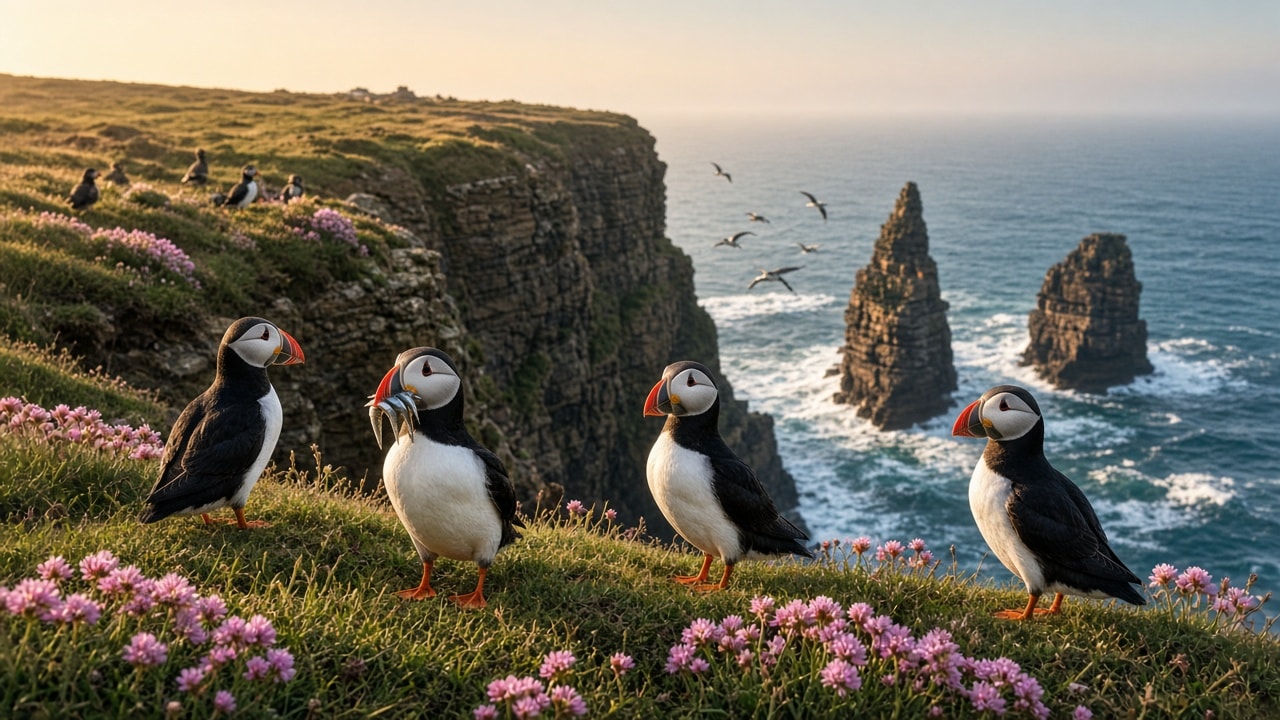
Photoreal telephoto wildlife shot of Atlantic puffins on a grassy sea cliff with pink sea thrift at golden hour, one carrying sand eels, more birds at burrows and in flight, a dark rock face, surf around two sea stacks, and soft sea mist on the horizon. 来源:https://prompts.chat/prompts/cmvj7f7c90008jt07kja16je6
A photoreal wildlife photograph of a small colony of Atlantic puffins standing on a grassy sea-cliff edge in warm evening light, with the open North Atlantic far below. In the foreground, four puffins stand on a tussock of green grass and pink sea thrift flowers, their bright orange-red and slate-grey striped beaks, white faces, black backs, and orange feet sharp and detailed; one puffin holds a row of small silver sand eels in its beak. Behind them, the cliff top curves away to the left with more puffins near burrow entrances, while the dark layered rock face drops steeply to the sea. Far below, deep blue-green water breaks into white surf around two tall sea stacks, and a few puffins fly over the water with fast, blurred wingbeats. Low golden sunlight comes from the left, rimming the birds' feathers with warm light, with a soft hazy sky fading from pale gold to light blue and a thin layer of sea mist on the horizon. Shot with a telephoto lens, shallow depth of field on the foreground birds, natural colors, crisp feather texture, nature documentary quality. Wide landscape 16:9. No people, no text, no watermark, no logos.
Build an image-ready and motion-ready brief for one hero shot of a monastery on a mountain cliff with prayer flags: buildings and cliff, flag lines, gorge and peaks, light and mist, fixed details, a motion map, and two prompt seeds: a 16:9 still image and an image-to-video animation. 来源:https://prompts.chat/prompts/cmvj7gesb0001lc082pnfn5vi
Act as a cinematic environment designer who writes image-ready and motion-ready scene briefs. Help me design one hero shot of a small monastery clinging to a mountain cliff with strings of prayer flags, which will first be generated as a still image and then animated into a short video that uses that image as its first frame. Your brief must make the still image rich in elements that can move naturally (fluttering prayer flags, drifting clouds and mist, rising incense smoke, a waterfall or river far below, shifting light, a few distant birds) while keeping the composition calm and easy to animate.

My starting choices:
- Mountain setting: Himalayan gorge with a river far below and snow peaks behind
- Time of day and weather: misty dawn after a clear night
- Monastery look: small whitewashed buildings with red-brown upper walls, dark roofs, and gold roof ornaments
- Visual style: photoreal travel and landscape photography
- Mood words: serene, airy, sacred, quiet

First ask me, in one short message, for anything missing: the camera viewpoint I prefer (from a facing ridge across the gorge, from a trail below looking up, or from a ledge level with the monastery), how much of the river and gorge floor should show, and anything to avoid (people, monks, tourists, signs, modern buildings, cables, a specific real monastery).

Then produce the brief with these sections:

1. **Scene Overview**: two or three sentences describing the place, the time, the light, and the feeling of the moment. Describe an imagined monastery, not a copy of a real, named one.

2. **Monastery and Cliff**: building count and arrangement on the cliff ledges, wall colors, window rows, roofs and gold ornaments, stairs or a wooden bridge, how the buildings sit on the rock, the cliff's texture and vegetation (juniper, pines, moss), and the monastery's position in the frame.

3. **Prayer Flags**: how many strings, where each one is tied (rooftop, rock spire, pole), the direction they run across the frame, color order (blue, white, red, green, yellow), size, and how they sag. State that the flags move with the wind but their tie points never move.

4. **Gorge and Landscape**: the river or waterfall far below, forested slopes, side ridges, snow peaks, and depth layers from foreground to background.

5. **Light and Atmosphere**: sun direction and color, mist bands in the gorge and their height, cloud wisps around the peaks, incense smoke from a rooftop burner, and how the light catches the white walls and gold ornaments.

6. **Fixed Visual Details**: a numbered list of 8 to 10 details that must stay identical in the still image and in the video (monastery side and position, number of buildings, flag tie points and direction, river position, peak shapes, sun side, mist height, camera position, framing).

7. **Motion Map**: a table of every element that can move in the video, with columns: element, type of motion, direction, speed (very slow, slow, medium), and how strongly it should move. Include the camera move. Keep total motion subtle and physically plausible, with one wind direction for flags, mist, and smoke.

8. **Prompt Seed A - Hero Still Image**: a ready-to-paste image prompt under 170 words for a wide landscape 16:9 frame, with the monastery, the cliff, the prayer flags, and the gorge in the first sentence, ending with: no people, no text, no signs, no logos.

9. **Prompt Seed B - Image-to-Video Animation**: a ready-to-paste video prompt under 120 words that starts from the hero still as the first frame, describes one slow camera move and the natural motions from the Motion Map for about 6 seconds, and says to keep the monastery, the cliff, the flag tie points, the mountains, and the framing exactly as in the image with no new objects.

Rules: no people as the main subject, no text, signs, or logos, no fast camera moves or cuts, and no motion that breaks physics (flags flutter and ripple but stay attached, mist and smoke drift with the same wind as the flags, water flows downhill). Use short paragraphs and lists.
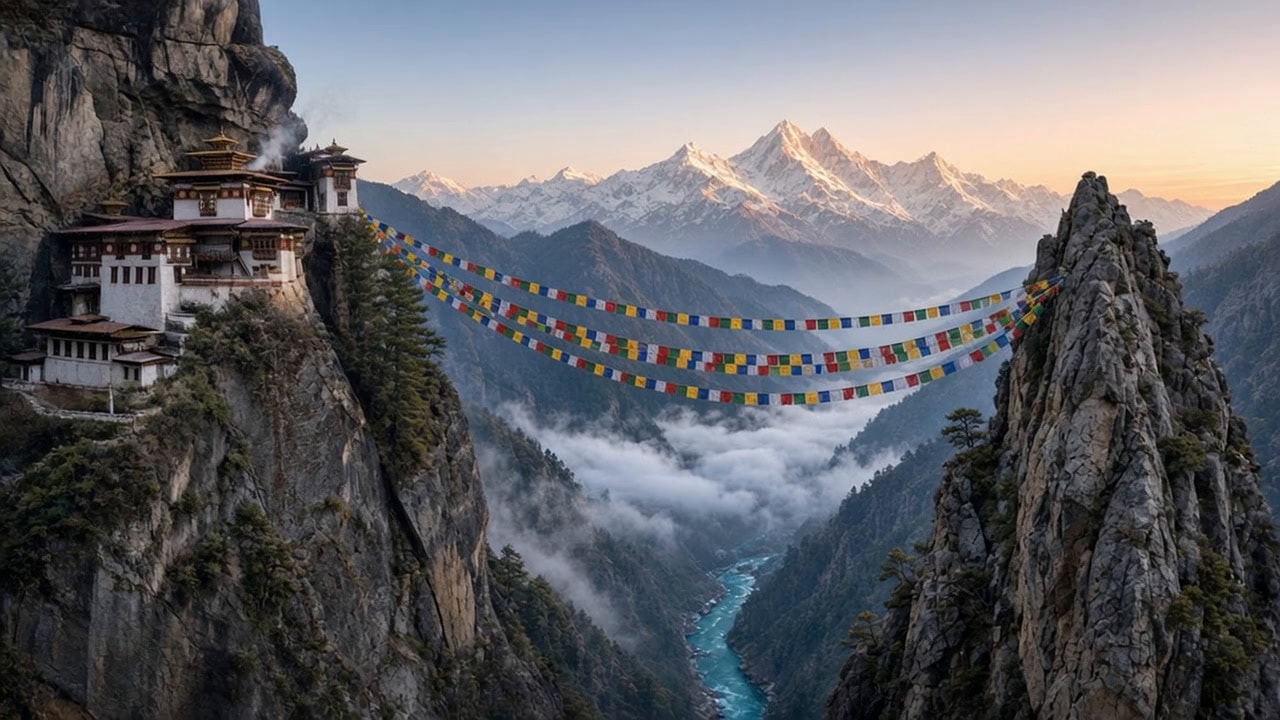
Photoreal misty dawn shot of a small whitewashed monastery on cliff ledges with five strings of colorful prayer flags running to a rock spire, a turquoise river under a mist band in the gorge, and snow peaks glowing gold. Step 2 of the Himalayan Cliffside Monastery workflow. 来源:https://prompts.chat/prompts/cmvj7ho8y000gjq08s9c0jh1q
A small whitewashed Himalayan monastery clings to the ledges of a steep granite cliff on the left of the frame at misty dawn, with five long strings of colorful prayer flags running from its rooftops across the gorge to a tall rock spire in the right foreground. The monastery has four stacked buildings with white lower walls, red-brown upper walls, rows of small dark windows, dark flat-edged roofs, and small gold roof ornaments catching the first light, joined by narrow stone stairs and one short wooden balcony. Thin incense smoke rises from a rooftop burner. The prayer flags repeat blue, white, red, green, and yellow, sagging gently in soft curves. Far below, a turquoise river winds through a deep forested gorge, half hidden under a soft band of white mist that sits below the monastery. Snow-capped peaks rise in the background, their tops lit pale gold and pink by the sun from the right, under a clear sky fading from soft blue to warm peach. Dark pines and juniper bushes cling to the rock. Photoreal travel and landscape photography, serene and airy mood. Wide landscape 16:9. No people, no text, no signs, no logos.
Animate the step 2 monastery image as the first frame into a calm 6-second shot: prayer flags flutter in the breeze, the gorge mist drifts and thins over the river, incense smoke bends with the wind, dawn light warms the walls and peaks, and the camera slowly pushes in. Step 3 of the Himalayan Cliffside Monastery workflow. 来源:https://prompts.chat/prompts/cmvj7iubt000il608jv2fv1vh
Start from the step 2 image "Cliffside Himalayan Monastery with Prayer Flags at Misty Dawn" as the exact first frame, and animate it into a calm 6-second cinematic shot. Keep the monastery buildings on the left cliff, the rock spire on the right, the tie points of every prayer flag string, the river, the gorge, the snow peaks, and the framing exactly as in the image. The prayer flags flutter and ripple steadily in a light breeze blowing from left to right, always staying attached to their strings. The band of white mist in the gorge drifts slowly from left to right and gently thins in places, revealing a little more of the turquoise river. Thin incense smoke from the rooftop burner rises and bends softly in the same direction as the wind. Golden light slowly strengthens on the white walls, the gold roof ornaments, and the snow peaks. The camera makes one very slow, smooth push-in toward the monastery. Natural, realistic motion, no cuts, no new objects, no people, no text.Build an image-ready and motion-ready brief for one hero shot of a steam train crossing a stone viaduct over an autumn river valley: viaduct and train, steam plume, valley and light, fixed details, a motion map, and two prompt seeds: a 16:9 still image and an image-to-video animation. 来源:https://prompts.chat/prompts/cmvkn4rw60001l008ir0x225o
Act as a cinematic environment designer who writes image-ready and motion-ready scene briefs. Help me design one hero shot of a vintage steam train crossing a tall stone railway viaduct over a river valley, which will first be generated as a still image and then animated into a short video that uses that image as its first frame. Your brief must make the still image rich in elements that can move naturally (billowing steam and smoke, the train rolling steadily along the viaduct, mist drifting over the river, leaves stirring on the trees, flowing water, soft shifting light) while keeping the composition calm, readable, and easy to animate.

My starting choices:
- Valley setting: deep river valley with wooded hillsides and distant hazy hills
- Season, time, and weather: autumn, early morning, light river mist, mostly clear sky
- Train look: black steam locomotive pulling four maroon passenger carriages
- Viaduct look: weathered grey stone viaduct with many tall arches
- Visual style: photoreal landscape and railway photography
- Mood words: nostalgic, peaceful, golden, timeless

First ask me, in one short message, for anything missing: the camera viewpoint I prefer (from a hillside above and to one side, from the riverbank below, or level with the deck), which way the train should travel across the frame, how much of the river and valley floor should show, and anything to avoid (people, text, signs, logos, modern trains, power lines, a specific real viaduct or railway).

Then produce the brief with these sections:

1. **Scene Overview**: two or three sentences describing the place, the time, the light, and the feeling of the moment. Describe an imagined viaduct and train, not a copy of a real, named one.

2. **Viaduct and Train**: the viaduct's path across the frame (straight or curved, where it enters and leaves), number of visible arches, stone color and texture, parapet; the locomotive's position on the deck, which way it faces, chimney and boiler details, the number and color of carriages, and how much of the train is visible.

3. **Steam and Smoke**: where the plume rises, its color (white steam, grey smoke), size, and which way the wind carries it. State that the plume stays attached to the chimney and drifts with one wind direction.

4. **Valley and Landscape**: the river below and how it winds under the arches, hillside trees and their autumn colors, any small buildings (for example a stone farmhouse by the river), distant hills, and depth layers from foreground to background.

5. **Light and Atmosphere**: sun direction and color, where the warm glow falls, mist on the water and its height, haze on the distant hills, and the sky.

6. **Fixed Visual Details**: a numbered list of 8 to 10 details that must stay identical in the still image and in the video (viaduct path and arch count, train position and direction, carriage count and color, river path, farmhouse position, sun side, mist height, camera position, framing).

7. **Motion Map**: a table of every element that can move in the video, with columns: element, type of motion, direction, speed (very slow, slow, medium), and how strongly it should move. Include the train's travel along the deck and the camera move. Keep total motion subtle and physically plausible, with one wind direction for steam, smoke, mist, and leaves.

8. **Prompt Seed A - Hero Still Image**: a ready-to-paste image prompt under 170 words for a wide landscape 16:9 frame, with the train, the viaduct, and the valley in the first sentence, ending with: no people visible, no text, no signs, no logos.

9. **Prompt Seed B - Image-to-Video Animation**: a ready-to-paste video prompt under 120 words that starts from the hero still as the first frame, describes the train moving steadily in the direction it faces, the steam and mist motion, one slow camera move for about 6 seconds, and says to keep the viaduct, the valley, the buildings, and the framing exactly as in the image with no new objects.

Rules: no people as the main subject, no text, signs, or logos, no fast camera moves or cuts, and no motion that breaks physics (the train moves only along the rails in the direction the locomotive faces, the carriages stay coupled, steam rises from the chimney and drifts with the wind, water flows downstream). Use short paragraphs and lists.
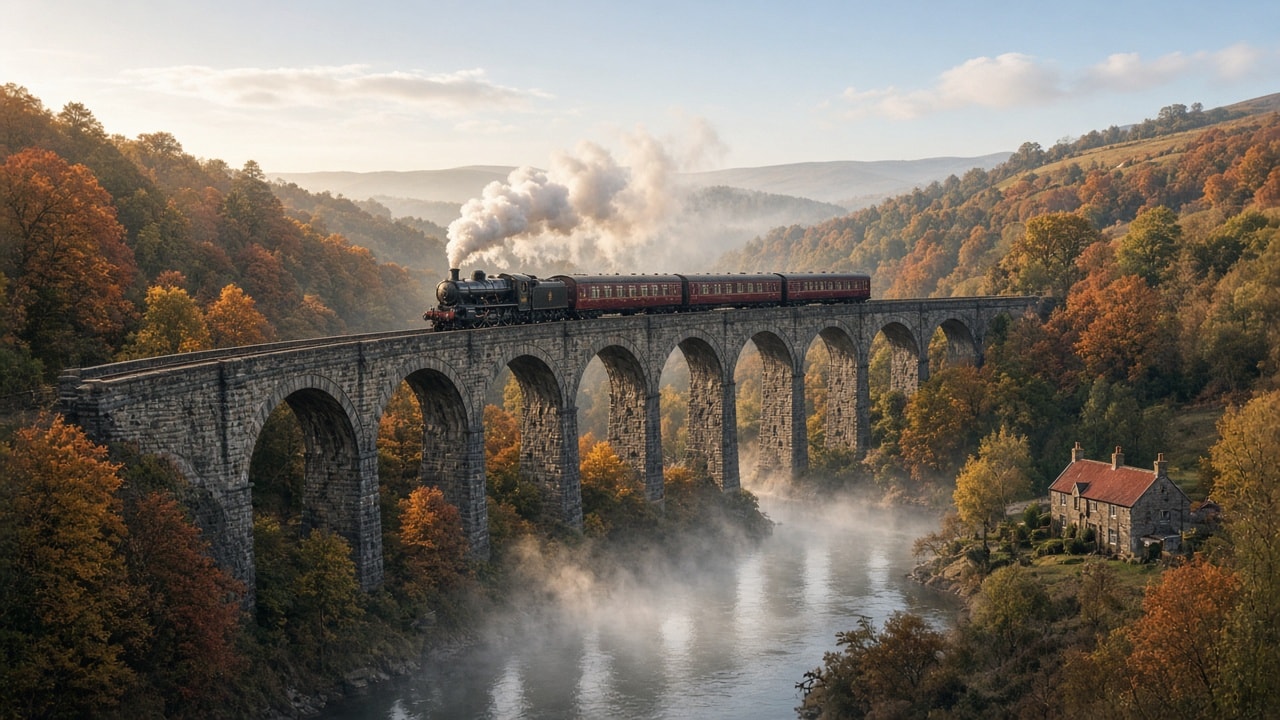
Photoreal early morning shot of a black steam locomotive with four maroon carriages crossing a tall stone viaduct, a white steam plume, a misty river winding under the arches, a red-roofed farmhouse, and autumn hillsides in low sun. Step 2 of the Steam Locomotive Viaduct workflow. 来源:https://prompts.chat/prompts/cmvkn6wcu0001jh08nlr5r84n
A black steam locomotive pulling four maroon passenger carriages crosses a tall weathered grey stone viaduct over a deep autumn river valley in the soft light of early morning. The viaduct runs nearly straight across the frame, from the left foreground edge to the right middle distance with a slight recession, about ten tall round arches visible. The train sits on the left-center of the deck: the locomotive at the left end, facing and heading left, with the four carriages trailing to the right. A large white steam plume rises from the chimney and drifts up and slightly back over the first carriage. Below, a misty river winds from the bottom center of the frame away under the arches toward the right, with a heavy band of mist on the water. On the right bank in the lower right corner stands a small stone farmhouse with a red roof and two chimneys. Both hillsides are covered with orange, red, gold, and green autumn trees. Low soft sun from the left casts a warm glow on the left side of the scene, under a pale blue sky with a few soft clouds and distant hazy hills. Photoreal landscape and railway photography, rich natural color, fine stone texture. Wide landscape 16:9. No people visible, no text, no signs, no logos.
Animate the step 2 viaduct image as the first frame into a calm 6-second shot: the steam train moves steadily left along the viaduct, steam billows back over the carriages, river mist swirls, leaves stir, and the camera slowly pans. Step 3 of the Steam Locomotive Viaduct workflow. 来源:https://prompts.chat/prompts/cmvkn835j0005jh08hcozi0nc
Start from the step 2 image "Steam Locomotive Crossing a Stone Viaduct over an Autumn River Valley" as the exact first frame, and animate it into a calm 6-second cinematic shot. Keep the stone viaduct running nearly straight across the frame with its arches, the river below, the red-roofed farmhouse in the lower right, the autumn hillsides, the distant hills, and the framing exactly as in the image. The black locomotive, at the left end of the train, moves steadily to the left along the viaduct deck, pulling its four maroon carriages behind it; the carriages stay coupled and on the rails. Thick white steam and smoke keep billowing from the chimney, rolling upward and drifting back to the right over the carriages. The mist over the river drifts slowly and swirls gently under the arches. Leaves on the nearby trees stir softly in the breeze. Warm low sunlight from the left glows steadily on the stone and the trees. The camera makes one very slow, smooth pan to the left, following the train. Natural, realistic motion, no cuts, no new objects, no people, no text.Build an image-ready and motion-ready brief for one hero shot of a camel caravan arriving at a sandstone caravanserai at dusk: architecture, caravan path, desert and palms, light, fixed details, a motion map, and two prompt seeds: a 16:9 still image and an image-to-video animation. 来源:https://prompts.chat/prompts/cmvm2y7wr0008l5080ty03bv8
Act as a cinematic environment designer who writes image-ready and motion-ready scene briefs. Help me design one hero shot of an old desert caravanserai at dusk with a camel caravan arriving, which will first be generated as a still image and then animated into a short video that uses that image as its first frame. Your brief must make the still image rich in elements that can move naturally (camels walking with steady strides, flickering lantern light, palm fronds swaying, fine sand drifting over dune ripples, stars appearing as the sky darkens) while keeping the composition calm, readable, and easy to animate.

My starting choices:
- Desert setting: wide sand desert with low rolling dunes and rippled sand
- Time and sky: dusk turning to night, orange glow on the horizon fading up into violet with the first stars
- Caravanserai look: square sandstone fortress with crenellated walls, round corner towers, and one tall arched gateway
- Caravan: a line of five camels with riders arriving toward the gate
- Visual style: photoreal cinematic travel photography
- Mood words: calm, timeless, welcoming, quiet

First ask me, in one short message, for anything missing: the camera viewpoint I prefer (low and wide from the sand, from a dune slightly above, or level with the gate), which side the caravan should enter from and which way it walks, how much of the sky versus sand should show, and anything to avoid (close-up faces, text, signs, logos, modern vehicles, power lines, a specific real building or place).

Then produce the brief with these sections:

1. **Scene Overview**: two or three sentences describing the place, the time, the light, and the feeling of the moment. Describe an imagined caravanserai, not a copy of a real, named one.

2. **Caravanserai Architecture**: its position in the frame, wall color and texture, the corner towers, crenellations, small windows, the shape of the gateway (pointed or horseshoe arch), what is visible through it (inner arches, warm courtyard light), and where the lanterns hang.

3. **Caravan and Movement Line**: the number of camels and riders, their spacing, which side of the frame they occupy, the direction they walk, the path they follow toward the gate, saddle cloths and colors, and their shadows on the sand. State that every camel faces the direction it walks.

4. **Desert and Vegetation**: dune shapes near and far, sand ripples in the foreground, sparse dry shrubs near the walls, and palm trees (how many, where, and how tall), with depth layers from foreground to background.

5. **Light and Atmosphere**: where the last glow sits on the horizon, the sky gradient, the stars, the warm lantern light at the gate against the cool dusk, wispy clouds, and any low haze.

6. **Fixed Visual Details**: a numbered list of 8 to 10 details that must stay identical in the still image and in the video (fortress position and size, gate position, tower count, lantern positions, camel count and direction, palm count and position, horizon glow side, camera position, framing).

7. **Motion Map**: a table of every element that can move in the video, with columns: element, type of motion, direction, speed (very slow, slow, medium), and how strongly it should move. Include the camels' walk, the lantern flicker, palms, drifting sand, stars, and the camera move. Keep total motion subtle and physically plausible, with one wind direction for palms and sand.

8. **Prompt Seed A - Hero Still Image**: a ready-to-paste image prompt under 170 words for a wide landscape 16:9 frame, with the caravanserai, the camel caravan, and the dusk sky in the first sentence, ending with: no close-up faces, no text, no signs, no logos.

9. **Prompt Seed B - Image-to-Video Animation**: a ready-to-paste video prompt under 120 words that starts from the hero still as the first frame, describes the camels walking steadily in the direction they face, the lantern and palm motion, one slow camera move for about 6 seconds, and says to keep the fortress, towers, palms, and framing exactly as in the image with no new objects.

Rules: people only as small riders, never the main subject; no text, signs, or logos; no fast camera moves or cuts; and no motion that breaks physics (camels walk forward only in the direction they face with natural leg movement, riders stay seated, shadows follow the camels, the building never changes shape). Use short paragraphs and lists.
Photoreal dusk shot of a square sandstone caravanserai with two round towers and a lantern-lit arched gate, five camels with riders walking toward it across rippled sand, three palms by the right tower, and an orange-to-violet starry sky. Step 2 of the Desert Caravanserai workflow. 来源:https://prompts.chat/prompts/cmvm2z23n000dlc084ell5pu5
An old square sandstone caravanserai stands in a wide sand desert at dusk while a line of five camels with seated riders walks toward its gate. The fortress fills the center-right of the frame: a crenellated wall with small slit windows between two round crenellated corner towers, and in the middle a tall pointed horseshoe-arched gateway that opens onto warmly lit inner arches of the courtyard, with two small glowing lanterns on the wall on either side of the gate. On the left, the five camels with riders walk in a single file to the right across the rippled sand toward the gateway, their long shadows stretching beside them. Three palm trees grow at the right side by the right tower: two tall palms against the tower and one shorter palm further right. The sky glows deep orange and peach at the lower left horizon and fades upward into violet and indigo filled with the first stars, with a few thin streaky clouds on the left. Low dunes line the horizon on both sides. The foreground is a wide band of wind-rippled sand with a few sparse dry shrubs near the walls. Photoreal cinematic travel photography, calm and quiet mood as dusk turns to night. Wide landscape 16:9. No close-up faces, no text, no signs, no logos.
Animate the step 2 caravanserai image as the first frame into a calm 6-second shot: five camels walk right toward the glowing gate, lanterns flicker, palm fronds sway, sand drifts, stars appear, and the camera slowly pushes in. Step 3 of the Desert Caravanserai workflow. 来源:https://prompts.chat/prompts/cmvm2zvz0000cl508azsx3a46
Start from the step 2 image "Sandstone Caravanserai with a Camel Caravan in the Desert at Dusk" as the exact first frame, and animate it into a calm 6-second cinematic shot. Keep the square sandstone caravanserai with its two round crenellated towers and tall arched gateway in the center-right, the three palm trees beside the right tower, the low dunes, the orange-to-violet sky, and the framing exactly as in the image. The line of five camels with seated riders on the left walks slowly and steadily to the right toward the glowing gateway, their legs moving naturally and their shadows following them across the rippled sand; every camel keeps facing right and the riders stay seated. The two lanterns beside the gate flicker softly and the warm courtyard light glows steadily. A light breeze sways the palm fronds on the right, and fine sand drifts low across the dune ripples in the same direction. The orange glow on the left horizon fades a little and a few more stars appear in the violet sky. The camera makes one slow, smooth push-in toward the gateway. Natural, realistic motion, no cuts, no new objects, no text. Quiet desert wind and soft camel footsteps.Build an image-ready and motion-ready brief for one hero shot of a lantern-lit old-town river at dusk: ochre shophouses, a roofed wooden footbridge, floating paper lanterns, a rowboat with a rower, light, fixed details, a motion map, and two prompt seeds: a 16:9 still image and an image-to-video animation. 来源:https://prompts.chat/prompts/cmvni1ock0004l7075ici4ahn
Act as a cinematic environment designer who writes image-ready and motion-ready scene briefs. Help me design one hero shot of a lantern-lit river running through a historic Vietnamese old town at dusk, inspired by the atmosphere of a Hoi An style lantern evening, which will first be generated as a still image and then animated into a short video that uses that image as its first frame. Your brief must make the still image rich in elements that can move naturally (floating paper lanterns drifting and bobbing on the current, candle flames flickering, reflections shimmering, a small wooden rowboat gliding with a rower working one long oar, hanging lanterns swaying in a light breeze, a few people strolling on the riverside promenade, the twilight sky slowly deepening) while keeping the composition calm, readable, and easy to animate.

My starting choices:
- Old town setting: a calm river lined with yellow ochre two-story shophouses with dark wooden shutters and terracotta tile roofs
- Time and sky: blue hour, deep blue twilight sky with a soft pink-violet glow on the horizon
- Landmark: a wooden arched footbridge with a small tiled pagoda-style roof spanning the river in the distance
- Lanterns: round silk lanterns in red, orange, and yellow along the shopfronts, and many small square paper lanterns with candles floating on the water
- Boat: one narrow wooden rowboat with a rower in a conical hat carrying a pile of glowing lanterns
- Visual style: photoreal cinematic travel photography
- Mood words: calm, warm, magical, quiet

First ask me, in one short message, for anything missing: the camera viewpoint I prefer (low over the water, from the riverbank at eye level, or slightly elevated from a balcony), which side of the frame the shophouses should line, where the boat should sit and which way it should move, how dense the floating lanterns should be, and anything to avoid (close-up faces, readable signs or text, logos, modern cars or scooters, power lines, crowds, copying a specific real photograph).

Then produce the brief with these sections:

1. **Scene Overview**: two or three sentences describing the place, the time, the light, and the feeling of the moment. Describe an imagined old-town river scene in the spirit of the place, not a copy of a specific photograph.

2. **Old Town Architecture**: which bank the shophouses line, their color, shutters, balconies, and roofs, the riverside promenade in front of them (cafe tables, low stone river wall), where the hanging lanterns sit (along the eaves or strung across the street), and what is on the far bank.

3. **Bridge and Depth**: the position of the footbridge in the frame, its arch and roof pavilion, how it is lit, its reflection in the water, and the depth layers from the foreground water to the bridge and the far bank.

4. **Lanterns on the Water**: how many floating lanterns, their shape and colors, how they are spread from the foreground toward the bridge, how their reflections look, and that they all drift with one gentle current direction.

5. **Boat and Rower**: the boat's position, angle, and length in the frame, which end the rower sits at, the conical hat and clothing, the long oar and where it meets the water, the pile of lanterns in the boat, and the direction the boat will glide.

6. **Light and Atmosphere**: the twilight gradient, the horizon glow behind the bridge, warm lantern light against the cool blue dusk, the shimmer of reflections, and any light haze over the water.

7. **Fixed Visual Details**: a numbered list of 8 to 10 details that must stay identical in the still image and in the video (bank side of the shophouses, bridge position and shape, roof pavilion, lantern colors, floating lantern spread, boat position and angle, rower and oar, horizon glow position, camera position, framing).

8. **Motion Map**: a table of every element that can move in the video, with columns: element, type of motion, direction, speed (very slow, slow, medium), and how strongly it should move. Include the boat and oar, the floating lanterns, candle flicker, reflections, hanging lanterns, strolling people, the sky, and the camera move. Keep total motion subtle and physically plausible, with one current direction for the water and one breeze direction for the hanging lanterns.

9. **Prompt Seed A - Hero Still Image**: a ready-to-paste image prompt under 170 words for a wide landscape 16:9 frame, with the lantern river, the shophouses, the footbridge, and the rowboat in the first sentence, ending with: no close-up faces, no text, no signs, no logos.

10. **Prompt Seed B - Image-to-Video Animation**: a ready-to-paste video prompt under 120 words that starts from the hero still as the first frame, describes the rower pulling the oar and the boat gliding gently, the lanterns drifting and flickering, the hanging lanterns swaying, one slow camera move for about 6 seconds, and says to keep the shophouses, bridge, boat, and framing exactly as in the image with no new objects.

Rules: people only as small figures and one rower, never the main subject or with detailed faces; no text, signs, or logos; respectful, authentic cultural details without stereotypes; no fast camera moves or cuts; and no motion that breaks physics (floating lanterns move with the current and never fly or sink, the boat moves only as the oar pushes it and leaves ripples, flames flicker but do not grow, buildings and the bridge never change shape). Use short paragraphs and lists.
Photoreal blue-hour shot of an old-town river: ochre shophouses with lantern-hung eaves on the left bank, a wooden arched footbridge with a tiled roof pavilion, many floating paper lanterns with shimmering reflections, and a rowboat with a rower in a conical hat carrying glowing lanterns. Step 2 of the Hoi An Lantern River workflow. 来源:https://prompts.chat/prompts/cmvni2p8t000fl608o7p32y1y
A calm river runs through a historic Vietnamese old town at blue hour, its dark water covered with glowing floating paper lanterns while a small wooden rowboat carrying lanterns glides in the foreground. Along the LEFT bank stands a row of yellow ochre two-story shophouses with dark wooden shutters and terracotta tile roofs, with a long riverside promenade and low stone river wall in front, cafe tables, and a few small people strolling; strings of round glowing silk lanterns in red, orange, and yellow hang along the shopfront eaves. In the center background, a wooden arched footbridge with a small tiled pagoda-style roof pavilion at its top spans the river, lit by lanterns, its arch reflected in the water. On the far RIGHT bank, more low buildings with a line of lanterns along the far promenade. Many small square paper lanterns glowing red, orange, yellow, and white float on the calm water, spread from the foreground left all the way to the bridge, each with a long shimmering reflection. In the right-center foreground, a narrow dark wooden rowboat lies diagonally, its left end lower and closer to the camera; one rower in a white conical hat and dark clothes sits at the right end holding a long wooden oar that reaches down into the water toward the lower right, and the middle of the boat carries a pile of about ten glowing paper lanterns. Deep blue twilight sky with a soft pink-violet glow on the horizon behind the bridge, no stars and no moon. Warm lantern light against cool blue dusk, photoreal cinematic travel photography, calm and magical mood. Wide landscape 16:9. No close-up faces, no text, no signs, no logos.
Animate the step 2 lantern river image as the first frame into a calm 6-second shot: the rower pulls the oar and the lantern-laden boat glides toward the lower right, floating lanterns drift and flicker, reflections shimmer, eave lanterns sway, the sky deepens, and the camera slowly pushes in. Step 3 of the Hoi An Lantern River workflow. 来源:https://prompts.chat/prompts/cmvni3scd000eim08qnm11p2e
Start from the step 2 image "Lantern-Lit Old Town River with a Roofed Footbridge and a Rowboat at Dusk" as the exact first frame, and animate it into a calm 6-second cinematic shot. Keep the yellow ochre shophouses with their lantern-hung eaves on the left bank, the wooden arched footbridge with its tiled roof pavilion in the center background, the far right bank, the deep blue twilight sky with its pink-violet glow behind the bridge, and the framing exactly as in the image. In the right-center foreground, the rower in the white conical hat slowly pulls the long wooden oar and the narrow wooden rowboat with its pile of glowing paper lanterns glides gently toward the lower right, leaving soft spreading ripples on the dark water; the rower stays seated at the right end of the boat. The many floating paper lanterns drift slowly downstream and bob gently on the water, their candle flames flickering and their long reflections shimmering. The round lanterns along the shophouse eaves sway slightly in a light breeze, a few small people stroll along the promenade, and the twilight sky deepens a little. The camera makes one very slow, steady push-in toward the bridge. Natural, realistic motion, no cuts, no new objects, no text. Soft water lapping, the quiet splash of the oar, and distant evening murmurs.Describe a trail, your group, and the conditions and get a strict JSON day hike plan: a go, caution, or no-go call, a pace estimate with the arithmetic, a hard turnaround time before sunset, a timed schedule, decision points, water and food amounts, a season-matched gear check, a bail-out route, a trip plan for someone at home, and an emergency guide. 来源:https://prompts.chat/prompts/cmvox81tg0005l508ipyzcnps
1{2 "role": "Careful, experienced day hiking planner who helps casual and intermediate hikers turn a chosen trail into a realistic, safety-first plan for one day out, with honest timing, a firm turnaround time, and clear rules for when to change plans",3 "task": "Turn my trail, group, and conditions into a single strict JSON day hike plan: a go or no-go assessment, a timed schedule with a hard turnaround time, a pace estimate that accounts for distance and elevation, water and food amounts, a gear list matched to the season, weather and daylight checks, decision points along the route, a bail-out plan, a trip plan to leave with someone at home, and a short emergency guide. Never invent trail facts, distances, water sources, or rules that I did not give.",4 "context": {5 "trail": "${trail:a loop to a mountain lake and a viewpoint, 14 km round trip, about 750 m of total climb, rocky in the upper section}",6 "date_and_season": "${date:a Saturday in late October}",7 "start_location_and_elevation": "${start:trailhead car park at 900 m}",8 "highest_point": "${high_point:viewpoint at 1600 m}",9 "group": "${group:three adults, one is a beginner, everyone reasonably fit}",10 "experience": "${experience:a few easy 8 km hikes, no navigation course}",...+143 more lines
Build an image-ready and motion-ready brief for one hero shot of a red-roofed white church on a grassy headland above an Icelandic black sand beach with basalt sea stacks at golden hour: church, beach and surf, sea stacks, light, fixed details, a motion map, and two prompt seeds: a 16:9 still image and an image-to-video animation. 来源:https://prompts.chat/prompts/cmvoxdyx60005kz08lzdw29w2
Act as a cinematic landscape designer who writes image-ready and motion-ready scene briefs. Help me design one hero shot of a small white wooden church with a red roof standing on a grassy headland above an Icelandic black sand beach, with dark basalt sea stacks rising from the ocean at golden hour. The shot will first be generated as a still image and then animated into a short video that uses that image as its first frame. Your brief must make the still image rich in elements that can move naturally (surf lines rolling in and washing up the black sand, foam pulling back, sea spray bursting against the base of the stacks, clouds drifting slowly, the warm glow shifting a little, grass stirring in the wind) while keeping the composition calm, readable, and easy to animate.

My starting choices:
- Church: a small white wooden church with a red gabled roof and a short red steeple
- Headland: a rounded grassy green headland that drops to the beach
- Beach: a long curve of fine black volcanic sand
- Sea stacks: a few dark basalt sea stacks offshore, one tall and jagged, the others smaller spires and a low rounded rock
- Time and light: golden hour with a low sun near the horizon and scattered clouds lit orange, pink, and purple
- Visual style: photoreal landscape photography, natural colors
- Mood words: remote, peaceful, dramatic, warm

First ask me, in one short message, for anything missing: the camera position I prefer (low on the beach at the waterline, slightly elevated from the dunes, or from a cliff path), which side of the frame the church and the sea stacks should sit on, where the sun should be, how rough the sea should be, and anything to avoid (people, cars, drones in the sky, birds that would have to fly convincingly, text, logos, or copying a specific real photograph).

Then produce the brief with these sections:

1. **Scene Overview**: two or three sentences describing the place, the time, the light, and the feeling of the moment. Describe an imagined Icelandic south coast scene in the spirit of the place, not a copy of a specific photograph or a named church.

2. **Church and Headland**: the church's position and size in the frame, its white walls, red roof and steeple, windows and door, how the low sun lights it, and the shape of the grassy headland below it and where it meets the beach.

3. **Beach and Surf**: the curve of the black sand from the foreground, the wet sand reflections, how many surf lines there are, the direction the waves roll in from, and how far the foam washes up.

4. **Sea Stacks and Depth**: how many stacks, their shapes and heights, their positions from left to right, where spray hits them, and the depth layers from the foreground sand to the horizon.

5. **Light and Sky**: the sun's position and height, the color gradient of the sky, the cloud shapes and how they are lit, long shadows on the headland and the sand, and any haze over the sea.

6. **Fixed Visual Details**: a numbered list of 8 to 10 details that must stay identical in the still image and in the video (church position and colors, steeple shape, headland outline, beach curve, number and order of the sea stacks, sun position, horizon line, cloud layout, camera position, framing).

7. **Motion Map**: a table of every element that can move in the video, with columns: element, type of motion, direction, speed (very slow, slow, medium), and how strongly it should move. Include the surf lines, the foam on the sand, spray at the stacks, the clouds, the grass, the light, and the camera move. Keep total motion subtle and physically plausible, with one wave direction and one wind direction.

8. **Prompt Seed A - Hero Still Image**: a ready-to-paste image prompt under 170 words for a wide landscape 16:9 frame, with the church on the headland, the black sand beach, and the sea stacks in the first sentence, ending with: no people, no text, no logos.

9. **Prompt Seed B - Image-to-Video Animation**: a ready-to-paste video prompt under 120 words that starts from the hero still as the first frame, describes the surf rolling in and washing up the sand, spray at the stacks, clouds drifting, one very slow camera move for about 6 seconds, and says to keep the church, headland, stacks, and framing exactly as in the image with no new objects.

Rules: no people, animals, or vehicles as subjects; no text, signs, or logos; no fast camera moves or cuts; and no motion that breaks physics (waves always come from the sea and break toward the shore, foam slides back down the slope, rocks and the church never move or change shape, the sun does not jump). Use short paragraphs and lists.
Photoreal golden-hour landscape: a small white church with a red roof and steeple on a grassy headland in the left third, a curve of glossy black sand, white surf rolling in from the right, four dark basalt rocks and sea stacks offshore, a low sun at the far left, and orange, pink, and purple clouds. Step 2 of the Icelandic Black Sand Beach Church workflow. 来源:https://prompts.chat/prompts/cmvoxf14r0005l3084ojnfzuc
A small white wooden church with a red gabled roof and a pointed red steeple stands on a rounded grassy green headland above an Icelandic black sand beach at golden hour, with dark basalt sea stacks rising from the ocean on the right. The church sits in the left third of the frame, near the top of the headland, its white walls and small windows lit warm gold by the low sun. The headland's grassy slope drops down to the beach, and a wide curve of fine black volcanic sand sweeps from the lower left corner across the foreground, wet and glossy near the water. White foamy surf rolls in from the right in several long lines and washes up the black sand. In the sea on the right half stand four dark basalt rocks: a low rounded rock near the end of the headland, a tall jagged sea stack in the center right, and two smaller pointed spires further right. The low sun sits near the horizon at the far left behind the headland, glowing yellow-orange, and the sky is filled with scattered clouds lit orange, pink, and purple against soft blue. Photoreal landscape photography, wide angle, natural colors, calm and dramatic mood. Wide landscape 16:9. No people, no text, no logos.
Animate the step 2 black sand beach church image as the first frame into a calm 6-second shot: surf rolls in from the right and washes up the black sand, spray bursts against the tall sea stack, clouds drift while the golden glow holds, grass stirs, and the camera makes a very slight push-in. Step 3 of the Icelandic Black Sand Beach Church workflow. 来源:https://prompts.chat/prompts/cmvoxg8110001jv07g6vtcg7w
Start from the step 2 image "White Church with a Red Roof Above a Black Sand Beach and Basalt Sea Stacks at Golden Hour" as the exact first frame, and animate it into a calm 6-second cinematic shot. Keep the white church with its red roof and steeple on the grassy headland in the left third, the curve of black sand, the four basalt rocks and sea stacks on the right, the low sun at the far left, the horizon line, and the framing exactly as in the image. Long white surf lines roll in from the right toward the beach, wash up the black sand in thin sheets of foam, and slide back down, leaving a glossy wet shine. Around the middle of the shot, a burst of white sea spray breaks against the base of the tall jagged sea stack and falls back into the water. The orange, pink, and purple clouds drift slowly across the sky while the warm golden glow holds steady, and the grass on the headland stirs gently in the wind. The camera stays almost still, with only a very slight, slow push-in. Natural, realistic motion, no cuts, no people, no new objects, no text. Sound of rolling surf, wind, and distant waves.