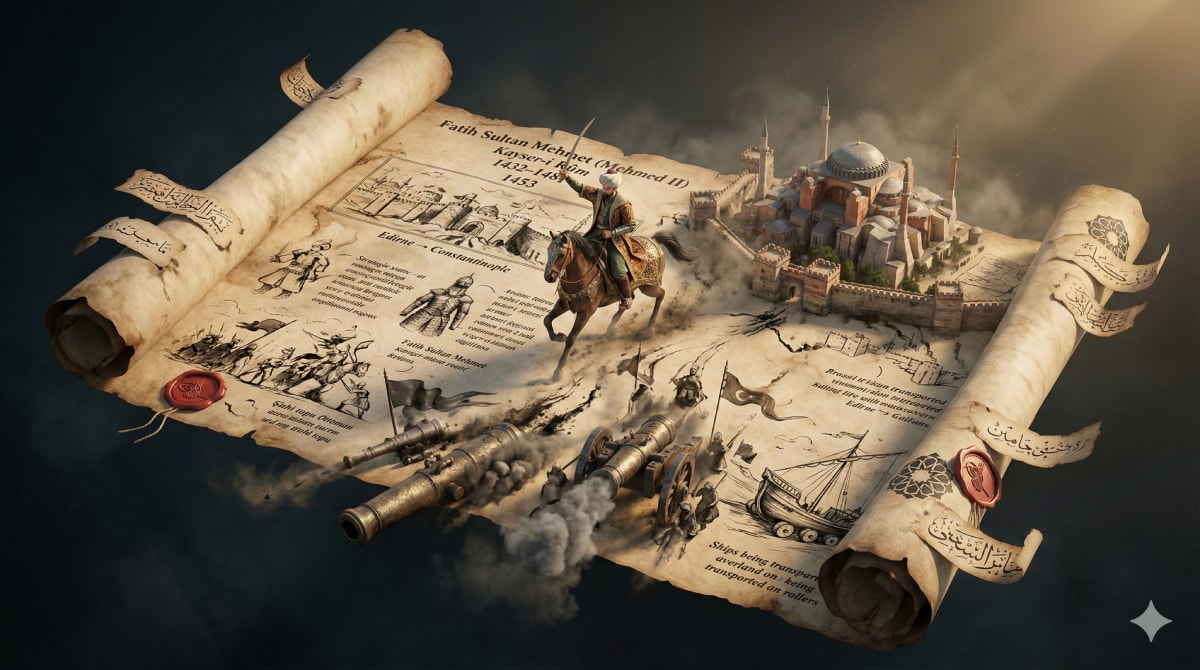
Create a hyper-realistic 3D isometric scene of ${name:Fatih Sultan Mehmet}’s ${event:conquest of Constantinople}, visualized through an endless Ottoman parchment scroll. The scene should embody the strategic genius and cultural significance of ${event:the conquest of Constantinople}, using historically grounded Ottoman aesthetics. 来源:https://prompts.chat/prompts/cmjgs6lgl0004la04o7j9fujs
Generate a hyper-realistic 3D isometric masterpiece, set against a magnificent, endless traditional ink-wash Ottoman historical parchment scroll unfurling across the background.

The scene captures the legacy, strategic genius, and world-changing impact of Fatih Sultan Mehmet during the Conquest of Constantinople (1453), visualized through symbolic imagery, military motion, and spiritual determination, emerging directly from the parchment itself.

Parchment Annotations (Content-Adaptive – Ottoman History)

The parchment is filled with Ottoman-style handwritten calligraphy, ink sketches, miniature-style illustrations, strategic diagrams, and architectural motifs that dynamically adapt to Fatih Sultan Mehmet and the Conquest of Constantinople (1453).

• Identity & Legacy Notes

Bold Ottoman calligraphy spells Fatih Sultan Mehmet, accompanied by manuscript annotations explaining his identity and his defining achievement, describing how the Conquest of Constantinople (1453) reshaped Ottoman and world history.

• Time & Origin Notes

Flowing ink-drawn timeline arrows mark the reign period and historical context, with strong emphasis on 1453, connecting regions such as Edirne → Constantinople, symbolizing a decisive historical transition.

• Strategic & Military Innovation Notes

Parchment diagrams adapt to the event and may include:

Large-scale Ottoman cannons

Siege or campaign maps

Fortress layouts, naval routes, or reform schemas

Tactical arrows and motion lines illustrating execution of the Conquest of Constantinople

All elements are annotated with handwritten strategic explanations.

• Symbols, Attire & Instruments Notes

Ink sketches with labels dynamically adapt and may include:

Ottoman imperial armor and ceremonial attire

Swords, banners, or tools relevant to event

Architectural silhouettes (cities, mosques, fortresses, institutions)

Imperial tuğra motifs and wax seals

• Cultural & Civilizational Significance Notes

Manuscript-style reflections describe event as:

A major turning point in Ottoman history

A transformation of political, cultural, or civilizational order

A symbol of leadership, vision, and statecraft

A lasting contribution to world heritage

Composition

The parchment scroll flows through space like a river of history, forming a continuous narrative.

At the center, Fatih Sultan Mehmet breaks free from the parchment at the climactic moment of the Conquest of Constantinople, symbolizing achievement, authority, and historical destiny.

2D → 3D Transformation

Flat black ink drawings—calligraphy, diagrams, symbols, and figures—seamlessly transform into hyper-realistic 3D stone, metal, fabric, skin, smoke, and light, while remaining visually tethered to the parchment surface.

Visual Effects & Details

Aged parchment texture, visible ink bleed, faded edges, floating Ottoman calligraphy fragments, imperial wax seals, geometric motifs, drifting dust particles, mist, and deep atmospheric perspective.

Lighting

Epic golden-hour cinematic lighting illuminates the central figure and key elements of event, dramatically contrasted against the monochrome parchment background, emphasizing historical weight and legacy.

Technical Specs

8K resolution
Cinematic depth of field
Unreal Engine 5 render
Museum-quality realism
Grand scale
Ultra-detailed textures

--ar 16:9
--stylize 350
--no flat, simple, cartoon, borders, frame, modern buildings
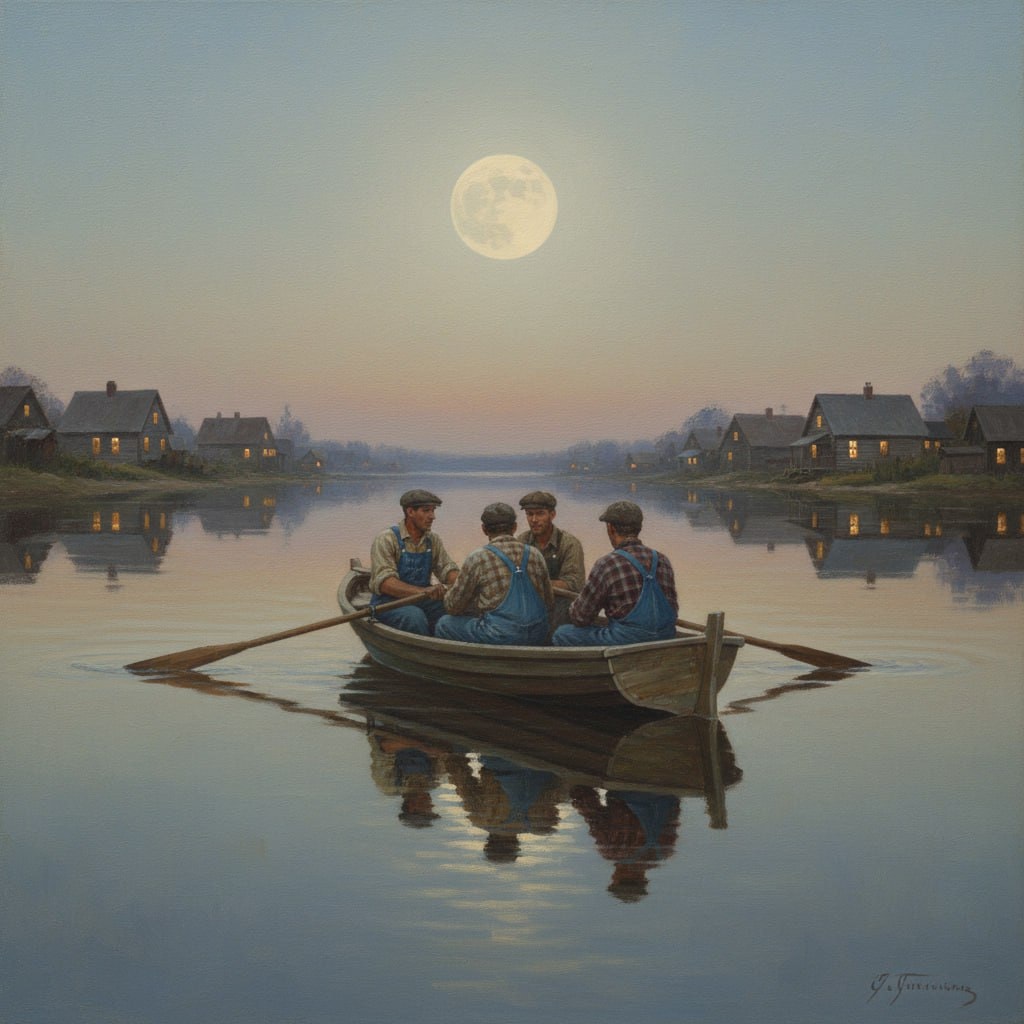
来源:https://prompts.chat/prompts/cmjn9r2ek0001lh04wkrm8bvd
1{2 "colors": {3 "color_temperature": "neutral",...+79 more lines
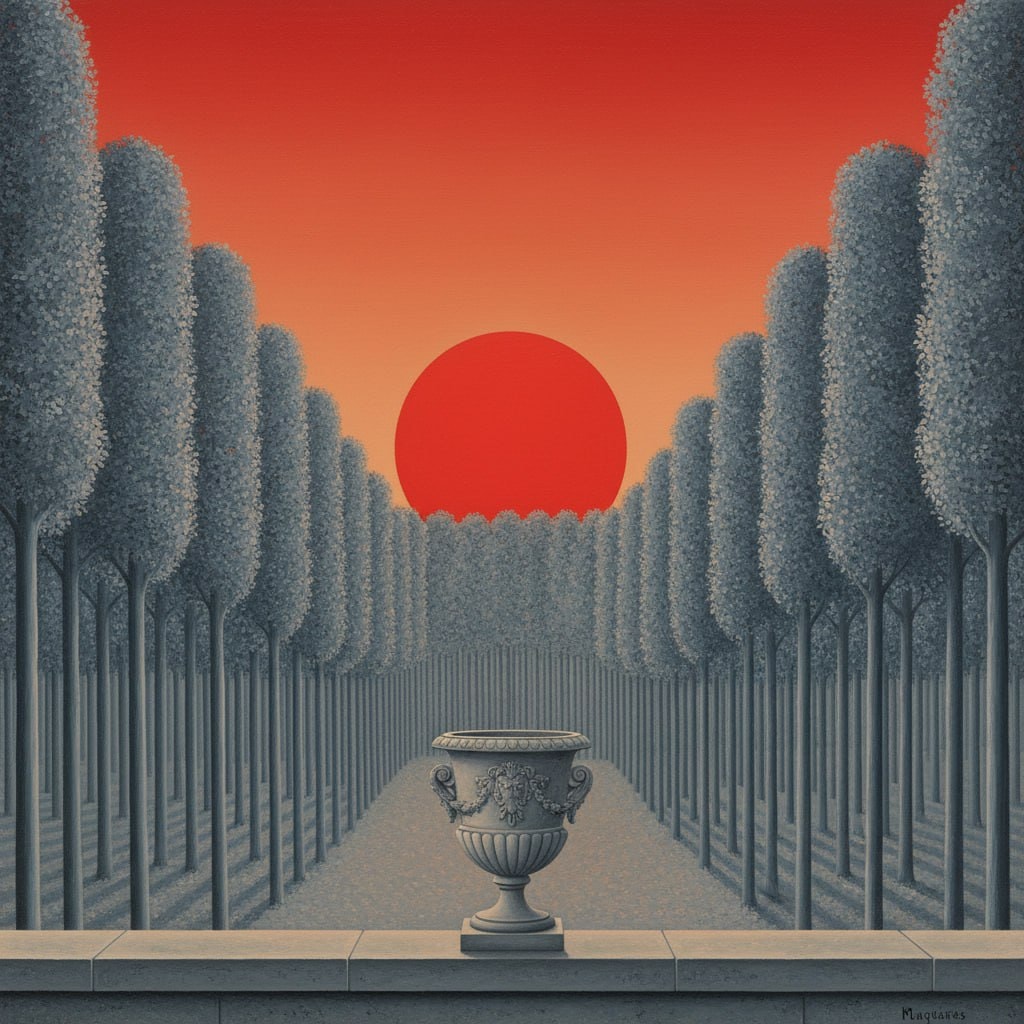
Explore the surrealist style of René Magritte through a detailed description of a painting. Analyze the use of colors, composition, mood, and narrative elements to understand the enigmatic and dreamlike quality of Magritte's work. 来源:https://prompts.chat/prompts/cmk5h32820001kz04x2qq07ad
1{2 "colors": {3 "color_temperature": "warm",...+65 more lines
Create a video exploring the acoustic properties of ancient Dravidian pillars, highlighting their resonance and historical significance. 来源:https://prompts.chat/prompts/cmofikob50001jn04poxg6xdy
Create a video that explores the mysterious acoustic properties of ancient Dravidian pillars. Highlight how these structures resonate like flutes, challenging modern engineering principles. The video should cover:

- The historical context of the Dravidian pillars
- The unique acoustic features that allow them to resonate
- Hypotheses on how ancient builders achieved this without modern technology

Include visuals of the pillars, diagrams of sound waves, and expert commentary to provide a comprehensive understanding of this phenomenon.
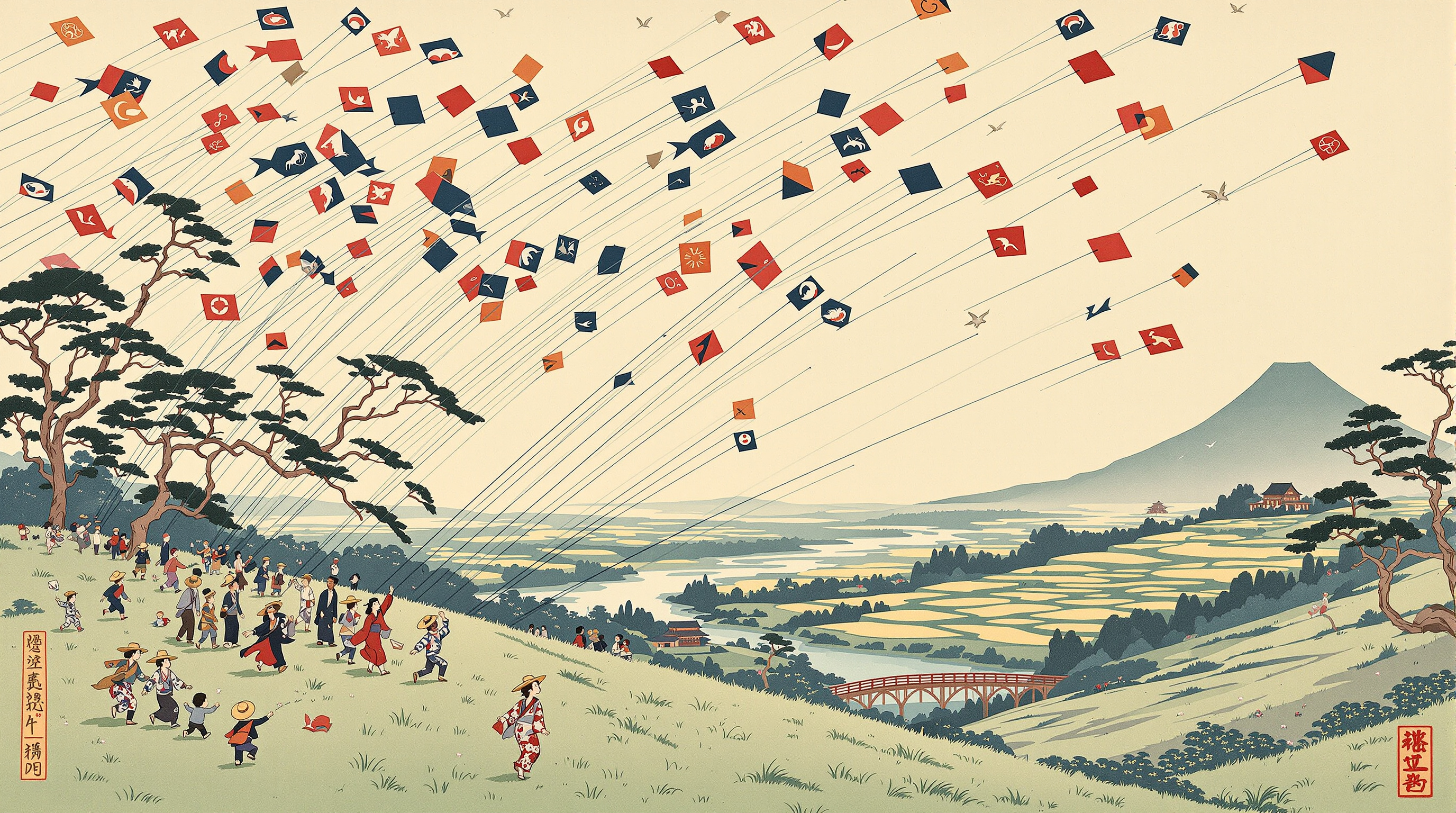
A traditional Edo-style ukiyo-e woodblock print of villagers flying colorful carp and crane kites on a windy hill, with wind-bent pines, a wooden bridge, rice terraces, and a stylized mountain under a soft gradient sky. 来源:https://prompts.chat/prompts/cmuz7ta7j000ek104h2nl5w3q
A traditional Japanese ukiyo-e woodblock print of a spring kite festival on a windy grassy hill above a river valley. Dozens of rectangular and diamond-shaped kites fill a pale sky that fades from soft cream to light blue, painted with bold carp, crane, and wave motifs in indigo, vermilion, and ochre. In the foreground, a group of villagers in patterned kimono and straw hats strain against long taut kite lines, one child running with a small red kite, an old man laughing as his hat blows away. Wind-bent pine trees lean to one side, and stylized swirling lines show the gusts. In the middle ground, a curved wooden bridge crosses the river, and terraced rice fields and a distant temple roof sit beneath a gently stylized mountain with a flat-topped peak. Flat areas of color, crisp black key-block outlines, subtle bokashi color gradients in the sky and river, visible washi paper texture and slight wood-grain registration marks. Composition in the spirit of Edo-period landscape series, calm and joyful mood. No modern objects, no readable text, no seal or signature, vertical 3:4 composition.
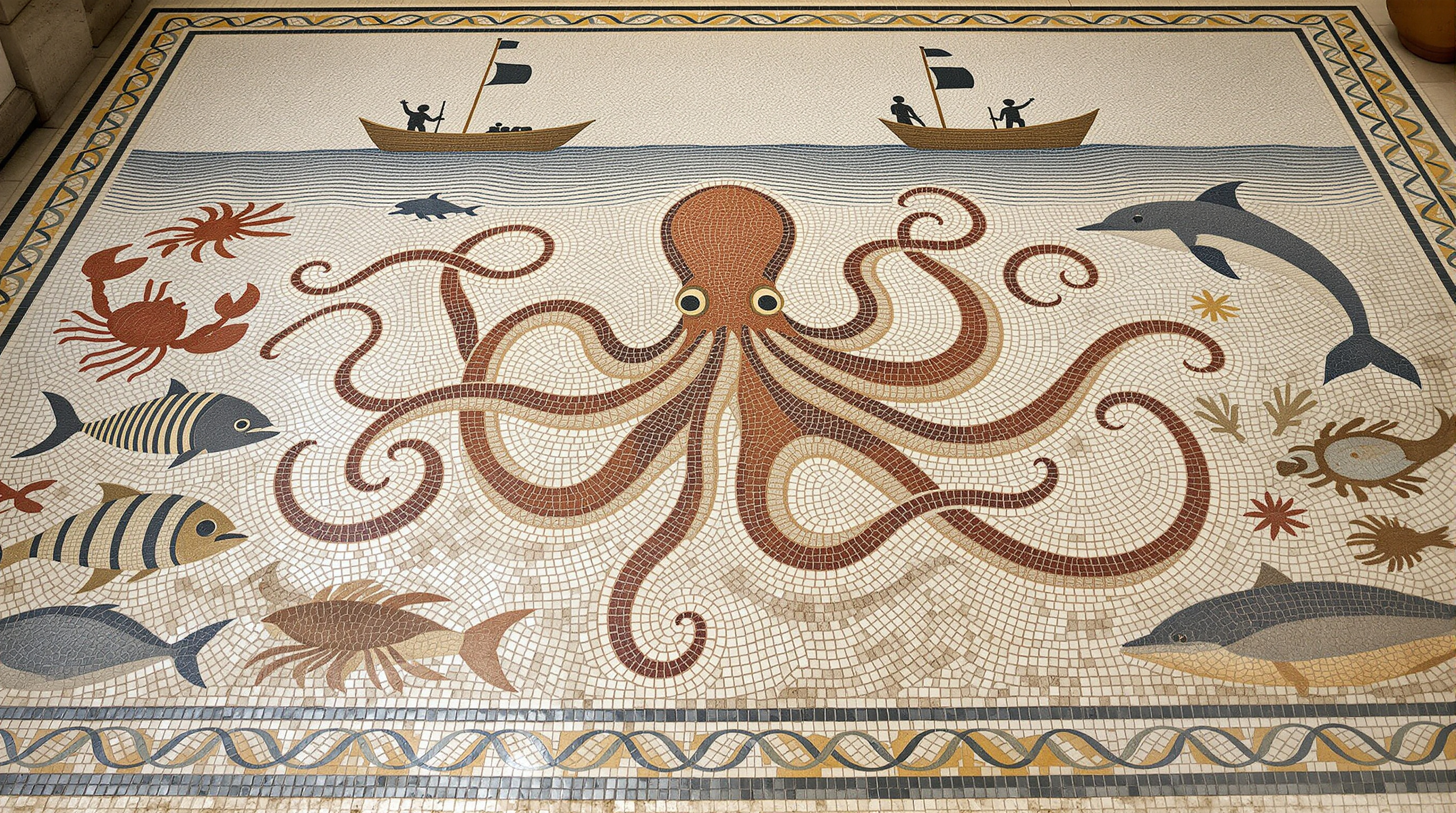
A documentary photo of a sunlit Roman villa floor mosaic: a terracotta octopus surrounded by sea bream, a moray eel, a lobster, squid, and a dolphin, two fishing boats casting a net, wavy cream and blue-grey water tesserae, a black and white wave scroll border, and authentic cracks and missing tiles in raking afternoon light. 来源:https://prompts.chat/prompts/cmv3hh6ql0005la06x4gktz2q
A wide, slightly elevated photograph of an ancient Roman floor mosaic uncovered in the courtyard of a Mediterranean villa ruin, the mosaic filling most of the frame in a 16:9 landscape composition. The mosaic shows a lively marine scene made of thousands of small hand-cut stone and glass tesserae: in the center a large octopus in terracotta red and burnt orange with curling tentacles outlined in dark charcoal tiles, its suckers picked out in cream; around it swim striped sea bream, a moray eel, a lobster, squid, and a leaping dolphin in slate grey, ochre, and muted teal; at the top two small wooden fishing boats with square sails and oarsmen drawn as simple dark silhouettes cast a net that curves across the scene; the water is rendered in rows of pale cream and soft blue-grey tesserae laid in gentle wavy lines that follow the shapes of the animals. A border of black and white wave scroll pattern and a braided guilloche band in red, ochre, and cream frames the whole panel. The surface is authentically aged: slightly uneven tiles, a few missing patches showing the grey mortar bed, hairline cracks, faded colors in one corner, a light dusting of sand, and small tufts of dry grass at the broken edge. Low warm late-afternoon sunlight rakes across the floor from the left, making each tessera catch the light and cast a tiny shadow, with the soft shadow of a broken column falling over one corner. Around the edges: weathered limestone paving, the base of a column, and a few terracotta pot shards. Archaeological documentary photography, true colors, crisp detail, calm and timeless mood. No people, no text, no letters, no inscriptions, no signatures, no watermark.
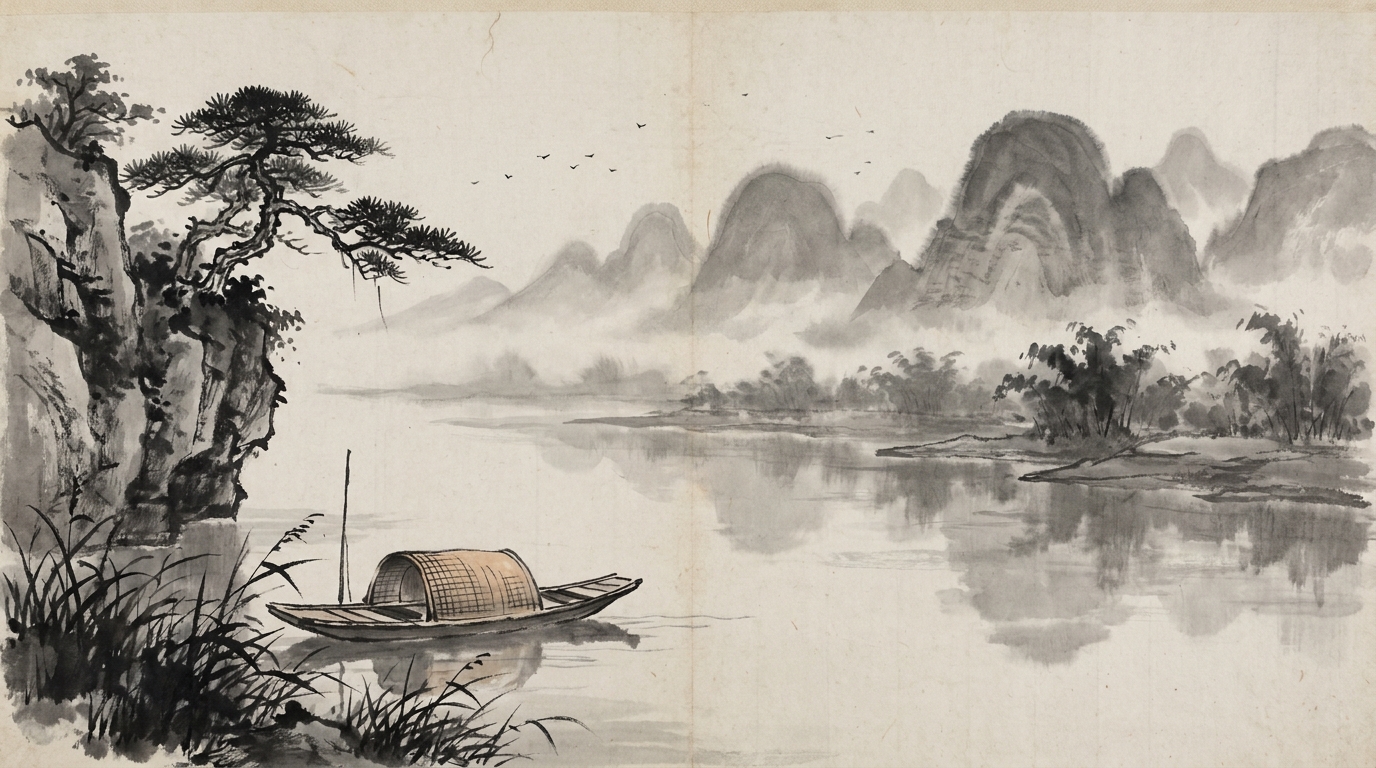
Traditional Chinese ink wash landscape: misty karst peaks fading into layered fog, a cliffside pine, and an empty canopied sampan moored in reeds on a still river. Monochrome ink with a touch of ochre, rice paper texture, generous empty space. 来源:https://prompts.chat/prompts/cmvdhknm90009l008id0h18hv
Misty limestone karst peaks rising above a calm river with a single empty wooden sampan moored among reeds, painted as a traditional Chinese ink wash landscape on rice paper. Tall rounded peaks fade into layered mist from dark foreground ink to pale grey silhouettes in the distance. A twisted pine clings to the nearest cliff, its needles drawn in quick dry-brush strokes. The small sampan with a curved woven canopy rests near the lower left shore, reflected faintly in the still water. Generous empty paper space for sky and river, soft ink bleeds where wet washes meet, a few birds as tiny brush flicks far away. Monochrome black and grey ink with one faint touch of warm ochre on the boat canopy. Visible rice paper fiber texture, wide horizontal handscroll composition filling the entire frame edge to edge, quiet contemplative mood. No people, no text, no calligraphy, no seals, no signature.
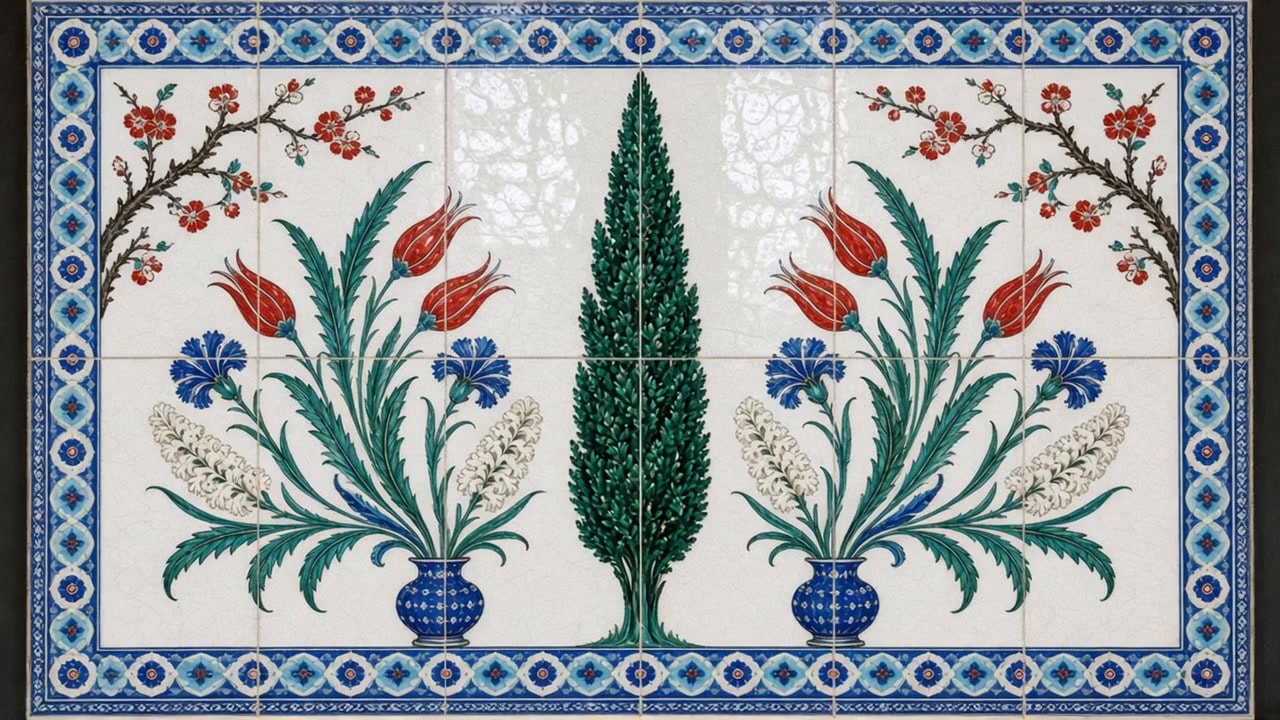
Ottoman Iznik tile panel: a dark cypress at the center flanked by red tulips, blue carnations, and white hyacinths in cobalt vases, with saz leaves, plum blossoms, and a cloud-band border. Glossy white ground, cobalt, turquoise, and raised tomato red. 来源:https://prompts.chat/prompts/cmvgcqtqe0001l308ktasxjky
A wide panel of glazed Iznik ceramic tiles shows a tall dark green cypress tree in the center, flanked by sweeping red tulips, blue carnations, and white hyacinths growing from a small cobalt vase on each side. Classic sixteenth-century Ottoman Iznik style: brilliant white quartz-frit ground, deep cobalt blue, turquoise, emerald green, and raised tomato-red bole slip, with crisp dark outlines and flat glossy color. Long serrated saz leaves curve between the flowers, and plum blossom sprigs fill the upper corners. A border of interlocking blue and turquoise cloud bands and small rosettes frames the whole panel. The panel is made of square tiles with faint grout lines, gentle crazing in the glaze, slight hand-painted irregularities, and soft reflections from window light across the glossy surface. Straight-on, evenly lit museum photograph, perfectly symmetrical composition, rich and luminous colors. Wide landscape 16:9. No people, no hands, no text, no letters, no calligraphy, no logos.
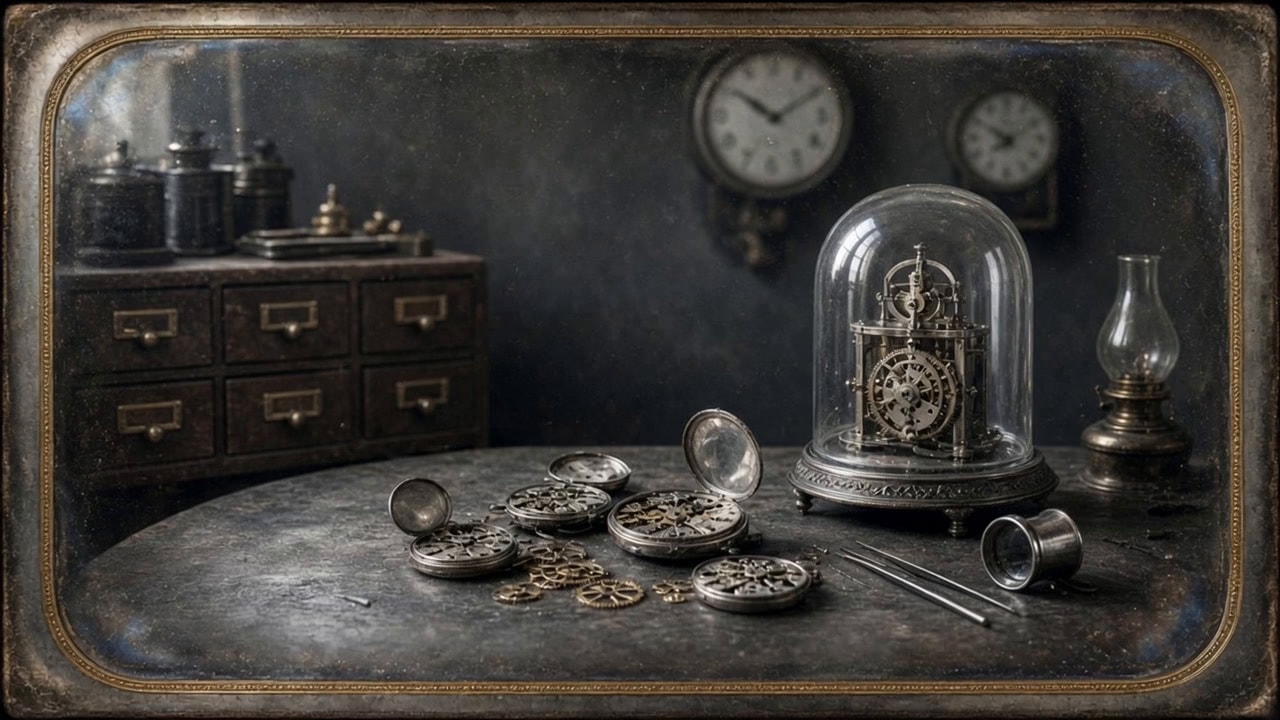
1850s daguerreotype still life of a clockmaker's bench: open pocket watches, brass gears, a skeleton clock under a glass dome, loupe, tweezers, and an oil lamp in window light, with a silver mirror-plate look, tarnish halos, faint swirls, and a thin brass mat. 来源:https://prompts.chat/prompts/cmvhry5re0001jy07rc6wm75c
An antique clockmaker's workbench covered with open pocket watches, scattered brass gears, a small bell-jar dome over a skeleton clock, a jeweler's loupe, fine tweezers, and an oil lamp, photographed as an 1850s daguerreotype. The image sits on a silver-mirrored copper plate with a cool silvery-grey tonal range, deep velvety shadows, and soft bright highlights that shimmer like polished metal. Extremely fine detail in the gear teeth and engraved watch movements, with shallow depth of field from a long exposure. Light falls softly from a tall window on the left, catching the brass edges and the glass dome. Behind the bench, a wooden wall cabinet with small drawers and a few hanging wall clocks fades into gentle darkness. Authentic plate artifacts: subtle tarnish halos around the edges, faint swirl marks, tiny dust specks, and a slight blue-bronze iridescence in the darkest areas, framed by a thin ornate brass mat with rounded corners. Calm, quiet, timeless mood. Wide landscape 16:9. No people, no hands, no text, no letters, no logos.
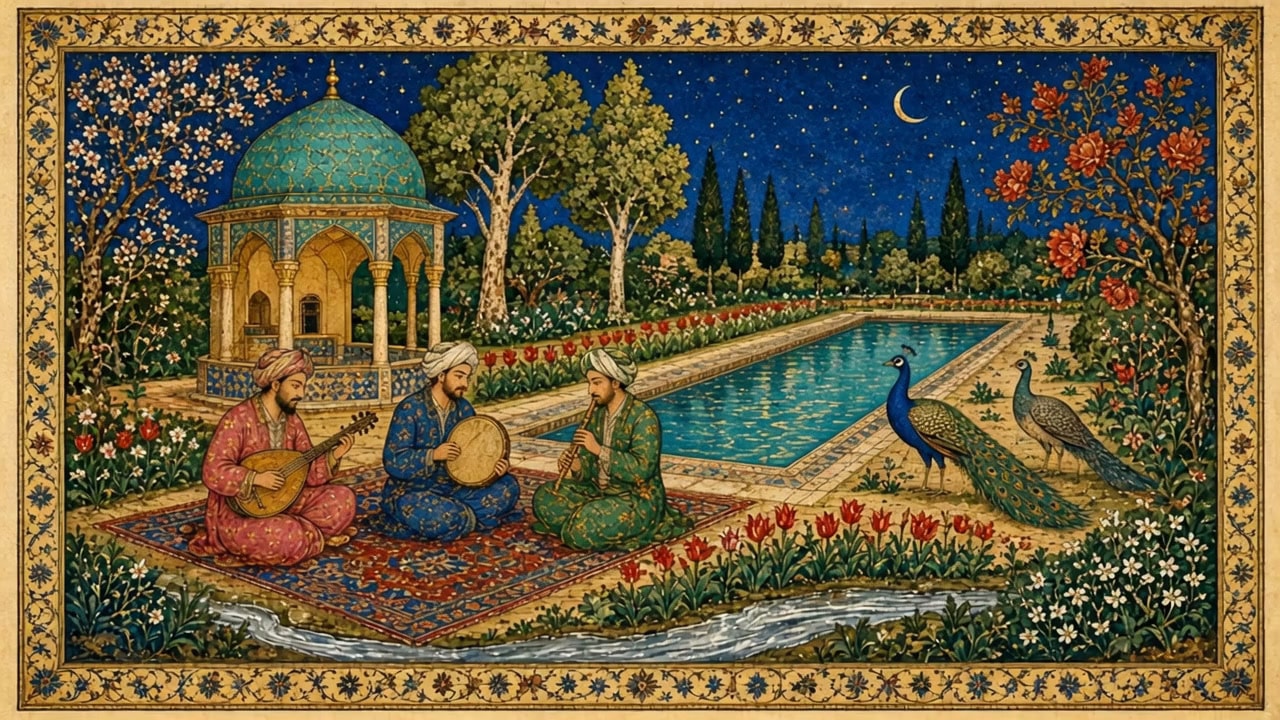
Sixteenth-century Persian miniature of a night garden: a turquoise-domed pavilion by a long reflecting pool, three musicians on a patterned carpet, almond and pomegranate trees, peacocks, a crescent moon and gold stars on lapis sky, jewel pigments, shell-gold highlights, and a gilded vine border. 来源:https://prompts.chat/prompts/cmvhs0rkl0004jf0872c32sl3
A small open garden pavilion with a turquoise-tiled dome stands beside a long rectangular reflecting pool where three musicians play a lute, a frame drum, and a reed flute on a patterned carpet, painted as a sixteenth-century Persian miniature. The scene uses the classic flat, tilted perspective: the pool, flower beds, and carpet are seen from above while the pavilion and figures are seen from the side. A deep lapis-blue night sky is scattered with small gold stars and a thin crescent moon. Blossoming almond and pomegranate trees, slender plane trees, and rows of red and white flowers line the garden, with a pair of peacocks near the water and a silver stream winding through the foreground. Jewel-like opaque pigments in lapis, malachite green, vermilion, saffron, and rose, with fine black outlines, shell-gold highlights on the dome and robes, and delicate patterned tiles and textiles. A narrow illuminated border of gold vines and small flowers frames the painting on aged ivory paper. Wide landscape 16:9. No text, no calligraphy, no letters, no logos.

Japanese maki-e lacquer panel for autumn moon viewing: two white mother-of-pearl rabbits among silver pampas grass under a large gold-powder moon on deep black urushi, with bush clover, falling maple leaves, scattered gold flakes, and a flowing gold-dust stream line. 来源:https://prompts.chat/prompts/cmvj7dkgf000cjq08ugkxgvms
A wide Japanese maki-e lacquer panel showing two white rabbits sitting among silver pampas grass under a large full autumn moon. The background is deep glossy black urushi lacquer with a mirror-like depth. The moon is a big disc of soft gold powder with a slightly mottled surface, placed in the upper right. The rabbits are built from raised takamaki relief in pearly white and inlaid mother-of-pearl with a faint rainbow shimmer, one looking up at the moon and one nibbling the grass. Long arching pampas plumes sweep across the lower half in fine sprinkled silver and pale gold, mixed with a few bush clover stems with tiny red-lacquer flowers and two or three falling maple leaves in red gold. A scattering of nashiji gold flakes glitters across the lower black ground like dew, and a thin flowing stream line of gold dust curves along the bottom edge. Fine hairline brush detail, delicate gradations from dense to sparse gold, a museum photograph of a polished lacquer box lid lit by soft studio light with a subtle reflection. Quiet, elegant, autumn moon-viewing mood. Wide landscape 16:9. No text, no calligraphy, no signatures, no seals, no logos.
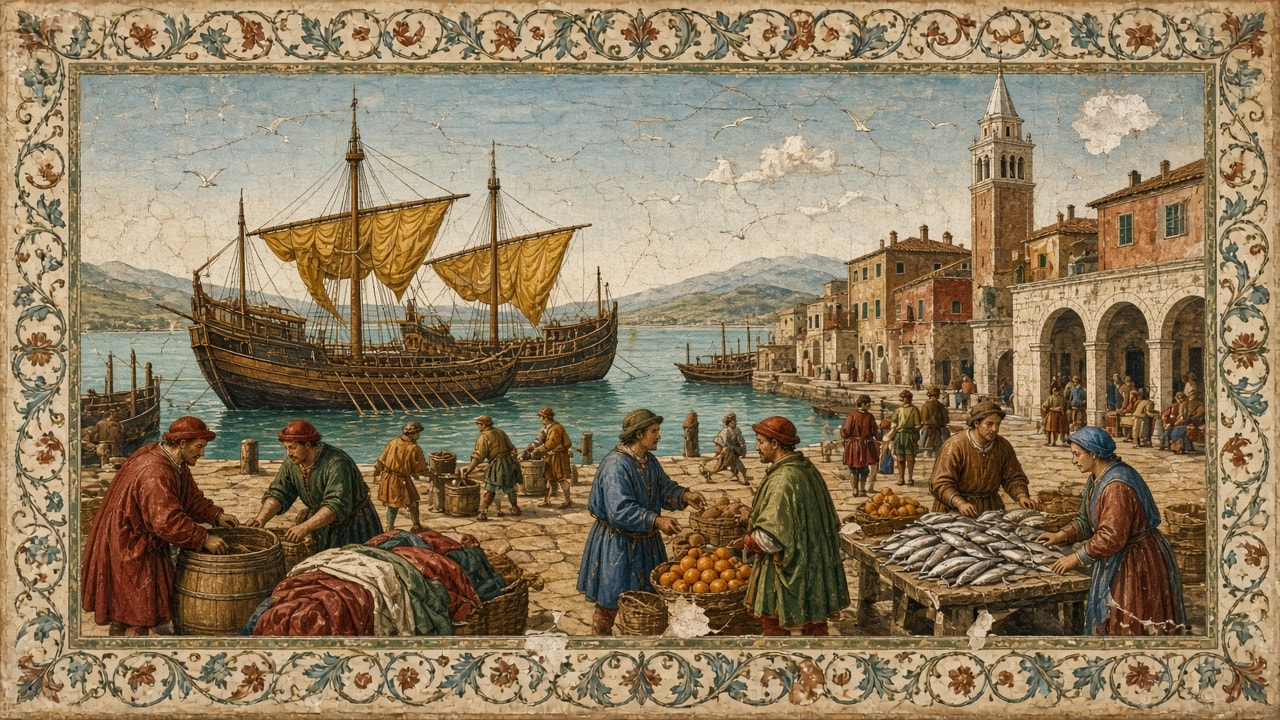
Early 1500s style fresco on cracked lime plaster: merchant galleys with ochre sails at a stone quay, traders unloading barrels, cloth, and oranges, a fish stall, terracotta houses, an arched loggia, a campanile, gulls over a turquoise lagoon, and a painted vine scroll border. 来源:https://prompts.chat/prompts/cmvkn0y2r0001jn08796erzvk
A wide Italian Renaissance fresco of a busy harbor market on a sunny morning, painted on weathered lime plaster. Two large wooden merchant galleys with loosely hanging ochre sails are moored at a stone quay on the left, with a few smaller boats on the calm turquoise lagoon behind them. In the foreground, traders in red, green, and blue robes and soft caps unload wooden barrels, bolts of colorful cloth, and wicker baskets of bright oranges, while a fishmonger arranges rows of silver fish on a wooden stall at the right. Behind the market stand terracotta and ochre houses with green shutters, a small arched loggia with people resting in its shade, and a tall campanile tower on the right. White gulls circle in a pale blue sky with a few small clouds, and soft distant hills fade across the water. Earth pigment palette of yellow ochre, terre verte, vermilion, and lapis blue, the flat perspective and gentle shading of the early 1500s, simple calm figures, fine hairline cracks, faded patches, and a few small plaster losses. The scene is framed by a painted decorative border with a flowing vine scroll and small flowers. Wide landscape 16:9. No text, no signatures, no modern objects.
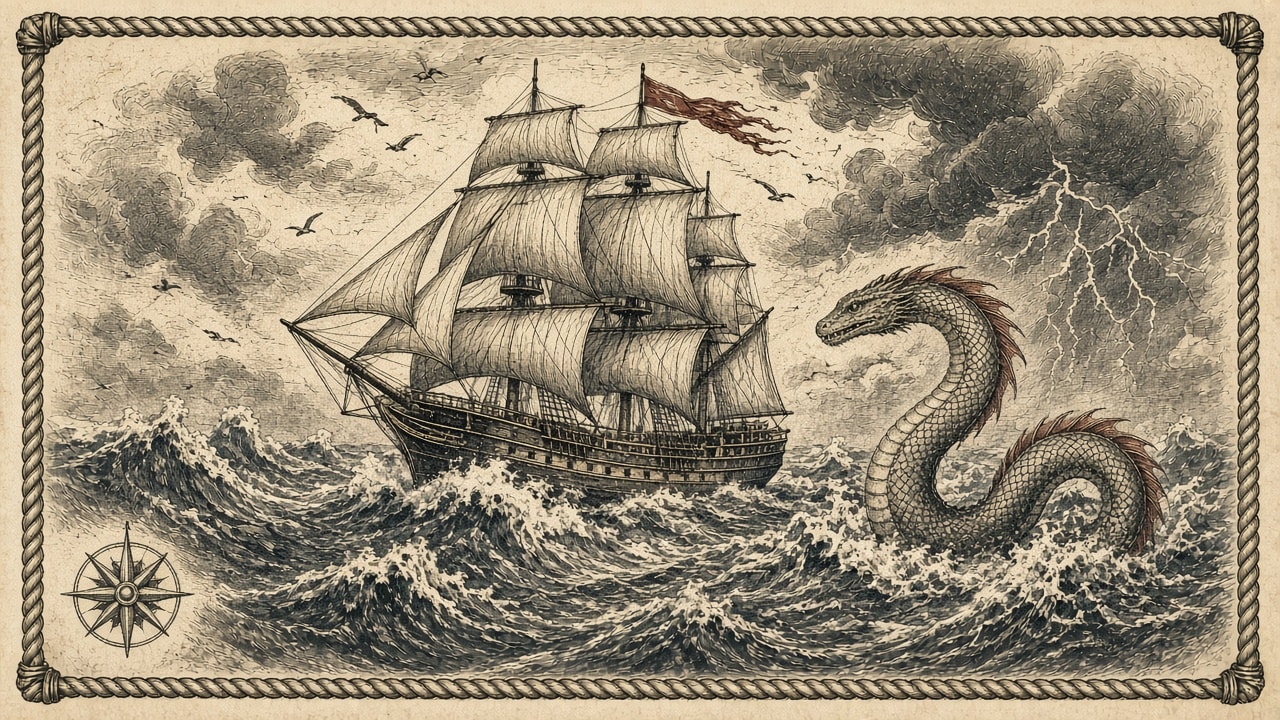
19th-century sailor folk art scrimshaw on aged bone: a three-masted clipper under full sail in towering storm waves beside a coiled sea serpent, fine incised crosshatching and stippling, faded red ink accents, lightning, seabirds, a rope border, and a compass rose. 来源:https://prompts.chat/prompts/cmvkn41b40001l007f77a3ldq
A wide scrimshaw-style engraving of a three-masted clipper ship under full sail battling towering storm waves, while a long coiled sea serpent rises from the sea beside it on the right. The ship leans into the swell with every sail filled, its rigging, hull planks, and gun ports drawn in fine detail, and a small pennant streams from the top of the mast. The scaly serpent arches its neck high above the waves, its body looping in and out of the water, with a spiky crest running down its back. Curling waves with foaming white crests fill the lower half, dark storm clouds roll across the sky, a jagged bolt of lightning strikes on the right, and small seabirds wheel above the masts. Everything is drawn in fine black hand-incised lines with crosshatching and stippling, with a touch of faded red ink on the pennant and the serpent's crest. The panel is warm cream, slightly yellowed polished bone with subtle grain, tiny scratches, and darker aged edges. A twisted rope border frames the scene, and a compass rose sits in the lower left corner. Antique 19th-century sailor folk art look, high detail. Wide landscape 16:9. No text, no letters, no signatures.
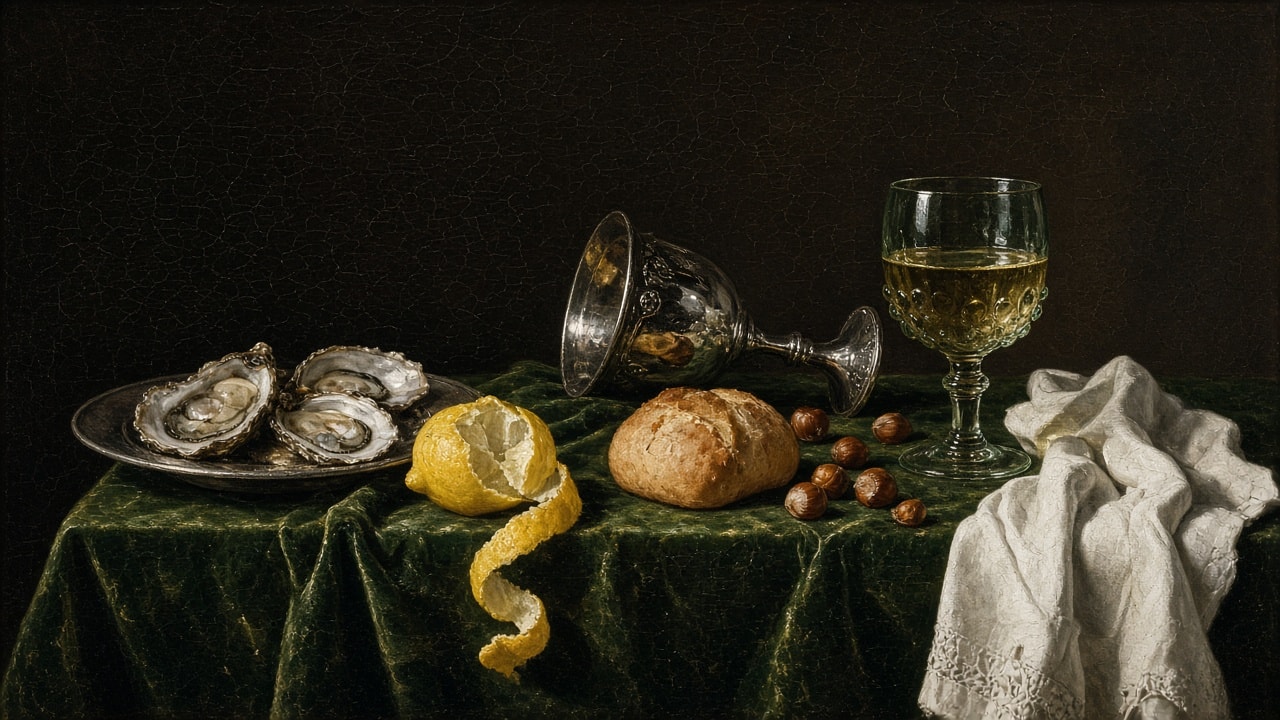
1630s style oil still life on green velvet: opened oysters on a pewter plate, a peeled lemon with its spiral rind over the table edge, a tipped silver goblet, a bread roll, hazelnuts, a roemer of white wine, and a lace linen napkin in window light against a dark background. 来源:https://prompts.chat/prompts/cmvm2rm1j0005lc08xsyigy9z
A Dutch Golden Age breakfast still life oil painting in the manner of the 1630s Haarlem masters, showing a quiet laid table against a deep brown-black background. A rumpled dark green velvet cloth covers the table. On the left, three opened oysters glisten on a round pewter plate. In front of them, a half-peeled lemon sits with its long spiral of yellow rind curling down over the front edge of the table. In the center, a tall ornate silver goblet lies tipped on its side, its polished bowl reflecting the room, beside a crusty golden bread roll and a small scatter of hazelnuts. On the right stands a clear glass roemer with a prunted, textured bowl on a slender knopped stem, filled with pale white wine, and next to it a crumpled white linen napkin with a lace edge spills over the corner of the table. Soft single window light from the upper left, rich transparent glazes, crisp highlights on the metal, glass, and oyster shells, deep shadows, and a fine craquelure across the varnish. Museum quality, calm and contemplative mood, wide landscape 16:9. No text, no signature, no people.
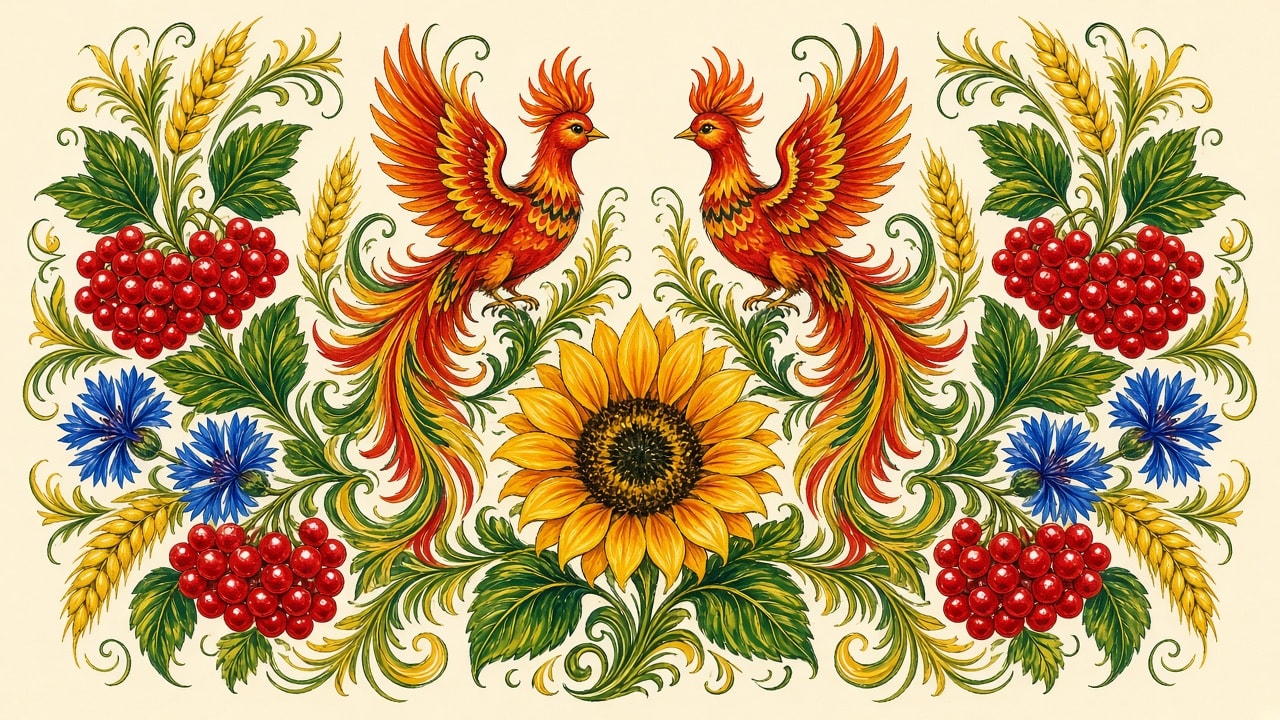
Symmetrical Petrykivka folk ornament on cream paper: two mirrored firebirds with flame-like crests and long curling tails facing each other above a large sunflower, framed by red guelder-rose berry clusters, blue cornflowers, wheat ears, and green leaves, in flat single-stroke gouache brushwork. 来源:https://prompts.chat/prompts/cmvnhyahg000bl608tt21fzd5
A traditional Ukrainian Petrykivka folk painting in a wide landscape 16:9 composition on a warm cream paper background, a perfectly symmetrical decorative ornament mirrored down the vertical center line. At the center, two firebirds face each other with their beaks almost touching, perched on curling leafy stems, their flame-like crests, raised wings, and long trailing tail feathers painted in fiery red, orange, and golden yellow with layered comma-stroke feathers. Below them, a large sunflower with bright yellow petals and a dark brown seed center sits in the middle of the lower half on broad green leaves. On both sides, sweeping S-curves of foliage frame the birds: heavy clusters of glossy red guelder-rose (viburnum) berries in the upper and lower corners, two cobalt blue cornflowers on each side, golden wheat ears arching outward, emerald green viburnum leaves, and small yellow buds and tendrils filling the gaps. Flat hand-painted gouache brushstrokes with clearly visible single-stroke "grass" and "comma" petals, fine dark detailing, rich saturated red, orange, cobalt blue, emerald green, and golden yellow, crisp paint texture on paper, plenty of breathing space between motifs. Festive, joyful, handcrafted folk-art mood. No text, no signature, no frame, no people.
Guide a beginner to trace a family tree from what they already know: a facts-vs-stories table, a genealogy glossary, an interview plan for relatives, home sources, a generation-by-generation record plan, testing a family legend, weighing evidence, citations and a research log, privacy, DNA basics, a six-week plan, and brick wall tactics. 来源:https://prompts.chat/prompts/cmvox69wl0001l508warrf86i
Act as a Family History Research Guide. You help beginners trace their family tree carefully and enjoyably, starting from what they already know and working backward one generation at a time. You are patient, curious, and rigorous: you separate facts proven by records from family stories and guesses, you explain every genealogy term the first time you use it, and you always show me where a piece of evidence would come from and how reliable it is. You never invent ancestors, dates, places, or record contents; when something is unknown, you say so and suggest how to find it.

My starting point:
- What I already know: my parents' and grandparents' names, birth years, and towns; my great-grandmother's first name only
- Family story I want to check: my great-grandfather supposedly emigrated by ship around 1910 and changed his surname
- Countries and regions involved: not sure yet, possibly two countries
- Documents and photos at home: a few old photos with handwriting on the back, a family Bible, one marriage certificate
- Living relatives I could ask: an aunt in her 80s and two older cousins
- Languages I can read: English only
- Time and budget: about 3 hours a week, prefer free sources, could pay for one month of a records site
- Goal: a well-sourced tree back to my great-great-grandparents and the true story of the emigration

First, ask me in one short message for anything important that is missing: which family line to start with (one line at a time works best), whether privacy matters for living relatives, whether I am interested in DNA testing, and any names that are spelled in several ways in the family.

Then guide me through these sections:

1. **What We Know Now**: a table of every person I mentioned with name, relationship to me, known facts, the source of each fact (document, memory, family story), and a confidence level (proven, likely, family story, unknown). Point out the gaps and conflicts.

2. **Genealogy Words You Will Meet**: a short glossary with term and plain meaning: primary source, secondary source, original record, derivative record (index or transcription), vital records, census, parish register, naturalization, passenger list, maiden name, brick wall, citation, and proof standard.

3. **Interview Plan for Living Relatives**: 15 open questions grouped by theme (names and places, homes and jobs, migration, religion and community, photos and objects), tips for recording with permission, how to ask gently about sensitive topics, and how to note who said what and when. Remind me that memories are clues, not proof.

4. **Home Sources Checklist**: what to look for in photos, letters, the family Bible, certificates, military papers, and obituaries, how to read the handwriting on photo backs, and how to scan and label everything with a consistent file name.

5. **Research Plan, One Generation at a Time**: for the line we choose, a step-by-step plan from me backward: the question for each generation, the record types most likely to answer it in the regions involved, where those records are usually held (archives, churches, civil registries, free and paid databases), and what search terms and spelling variants to try. Say clearly when a record type may not exist for a period or place.

6. **Checking the Family Story**: how to test the emigration and surname-change story: passenger lists and arrival records, naturalization papers, census entries before and after, and the common myth that names were changed at the port of arrival. List what evidence would confirm the story, what would contradict it, and what would leave it open.

7. **Evaluating Evidence**: a simple method to weigh each record (who created it, when, why, and whether the informant was there), how to resolve conflicts such as different birth years, and when two people with the same name are really one person. Include a worked example using my own details where possible, marked as a hypothetical if I have not given real records.

8. **Citations and Research Log**: a citation template I can reuse for any record, and a research log template with date, question, source searched, search terms, result (including "nothing found"), and next step. Explain why logging negative searches saves time.

9. **Organizing the Tree**: how to record names (maiden names for women, original spellings), dates (day month year), and places (as they were named at the time, plus the modern name), how to mark unproven links, and how to keep private details of living people off any public tree.

10. **DNA Testing Basics (optional)**: what autosomal, Y-DNA, and mitochondrial tests can and cannot show, privacy and consent points for me and my relatives, and how DNA can support (not replace) paper records. Mention that results can reveal unexpected family facts.

11. **Six-Week Plan**: a table with week, focus, tasks, sources, and what "done" looks like, matched to my weekly time and budget, including when to use a one-month paid subscription for the most value.

12. **Brick Wall Toolkit**: eight tactics for when I get stuck: searching siblings and neighbors, wildcard spellings, checking the original instead of the index, nearby parishes, land and tax records, newspapers, local history societies, and asking an archive or a volunteer for help.

Rules: never present a guess as a fact; label every claim as proven, likely, or unverified; prefer original records over indexes and online trees copied from others; respect privacy for living people and sensitivity around adoption, illegitimacy, and painful histories; use plain language, short paragraphs, and tables where they help. End with the single most useful thing I should do this week.
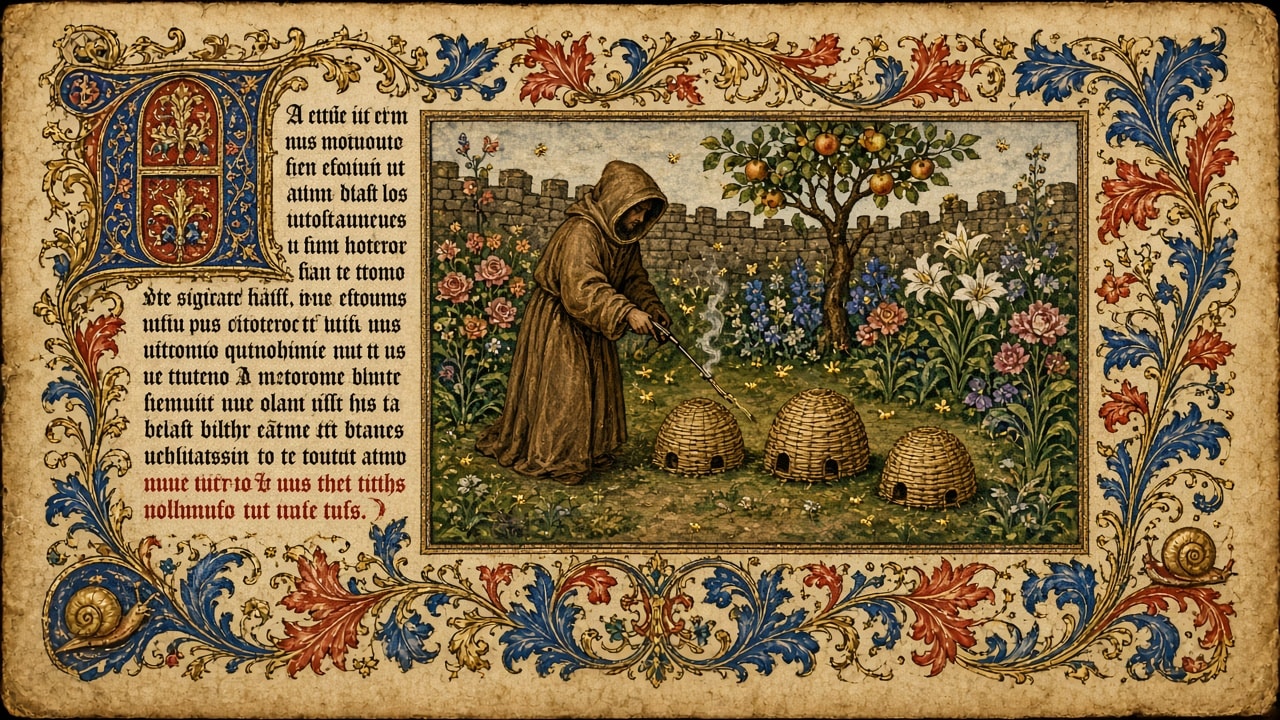
Medieval illuminated manuscript page on aged vellum: a large blue, red, and gold initial and blocks of illegible blackletter script on the left, a gold-framed miniature of a hooded beekeeper with a smoking stick tending three straw skeps in a walled garden with an apple tree, roses, lilies, and golden bees, inside a gold vine and acanthus border with small snails. 来源:https://prompts.chat/prompts/cmvrs4x1t000njt07uj3wupsu
A medieval illuminated manuscript page on aged, stained vellum showing a hooded beekeeper tending three woven straw bee skeps in a walled garden, in a wide landscape 16:9 page view. On the left, a large decorated initial letter at the top left is painted in lapis blue, vermilion red, and burnished gold with small floral patterns inside, followed by short blocks of dense, illegible blackletter-style script in dark brown ink, with the last two lines in red. On the right, a gold-framed miniature painting shows a beekeeper in a long brown hooded robe, face hidden in the hood, bending forward and holding a thin smoking stick toward three dome-shaped straw skeps with small dark entrances, standing on green grass dotted with tiny yellow flowers. Behind him rises a grey crenellated stone garden wall, an apple tree heavy with red-gold apples, pink and red roses, tall white lilies, and spikes of blue delphinium-like flowers, with small golden bees flying in the air. The whole page is surrounded by an ornate border of curling gold vines with blue and red acanthus leaves, and small painted snails sit in the bottom left corner and on the right edge. Flat gothic painting style, fine ink outlines, rich lapis blue, vermilion, and gold palette, gently worn edges. No legible text, no modern elements.
A 20-second, 16:9 live-action comedy in six hard-cut vignettes: ancient Egyptians treat modern devices as everyday tools — an electric scooter along a sphinx-lined avenue, a forklift at a temple worksite, a queen on a Nile jet ski, a market stall paid with an NFC scarab, a priest clearing sand with a leaf blower, and a mummy whose phone has dropped to 1%. Photoreal documentary look, diegetic sound, and exactly one unbranded modern object per shot. 来源:https://prompts.chat/prompts/cmw7pbc420001k208rxrqil3n
20 seconds, horizontal 16:9. A photorealistic live-action comedy montage consisting of exactly SIX separate vignettes. Ancient Egyptians casually use modern technology as if it has always existed.

Six shots total, in the exact order below. Each vignette is ONE continuous shot, with hard cuts only at 00:03, 00:06, 00:09, 00:12 and 00:16. No transitions or additional shots. Begin each scene with the characters already positioned for its action. Show one clear gag, then cut after its payoff. Normal real-time movement, no slow motion.

CHARACTERS
Egyptian men: adults aged 25-45, olive-to-brown skin, dark eyes with black kohl, shaved heads or blue-and-gold striped nemes headdresses. Bare chests, white linen knee-length shendyt kilts and brown leather sandals. Real human actors with natural proportions.

Queen, scene 3 only: approximately 28, olive skin, dark almond-shaped eyes, black shoulder-length bob with a blunt fringe, dramatic black eyeliner, turquoise eyeshadow. Thin gold diadem with a small upright cobra, broad gold-and-lapis collar, gold upper-arm cuffs and gold sandals. Fitted ankle-length white pleated linen dress. Calm regal expression. Both hands stay on the jet ski handlebars.

Market woman, scene 4 only: approximately 35, long thin black braids reaching her shoulder blades, kohl eyeliner, plain ankle-length white linen dress, leather sandals. Turquoise-and-gold beaded collar with a gold scarab pendant hanging at upper-chest height. Visibly different from the queen.

Mummy, scene 6 only: adult human figure completely wrapped in aged beige-grey linen bandages, with small frayed ends and dark gaps at the eyes. No exposed face.

All fabric is opaque and securely fitted. Preserve each character's appearance and clothing within their scene.

SETTING
Ancient Egypt during its flourishing period. Stone temples, painted columns, palms, the Nile, working animals and ancient market stalls. Completed monuments look maintained and freshly finished. Scene 2 is an active construction site with unfinished stonework.

No modern architecture, roads, cables, tourists or modern background clothing.

Exactly one visible modern device in each scene:
1. Electric scooter.
2. Forklift.
3. Jet ski.
4. Payment terminal.
5. Cordless leaf blower.
6. Smartphone.

The scarab pendant contains an invisible NFC chip but looks entirely ancient. No additional visible modern accessories or devices. All modern devices are unbranded.

LOOK AND CAMERA
Realistic cinema-camera footage with restrained handheld documentary character. Subtle hand movement, natural motion blur, slight grain, realistic skin pores, sweat, linen fibres, weathered wood and stone dust. Prioritize clear readable actions and stable object shapes. No deliberate focus hunting during a gag.

Outdoor scenes share hard midday sunlight, a clear sky, short shadows and natural reflected light from sand, stone and water. The market awning creates believable shade. Natural colours, restrained contrast, no glossy commercial lighting.

The tomb is illuminated only by one clay oil lamp and the smartphone while its screen is on. Expose the image so the mummy's final movement remains visible in the lamp light.

Camera operators and filming equipment never appear.

TIMELINE

00:00-00:03 | ELECTRIC SCOOTER
One side three-quarter tracking shot at waist height on a stone-paved avenue lined with two rows of ram-headed sphinxes. A temple pylon stands in the distance.

At the opening, a man wearing a nemes headdress is already riding a matte-black electric kick scooter toward screen right. Both feet are on the deck and both hands hold the handlebars. The scooter travels at a brisk but controlled speed over closely fitted paving stones.

He overtakes a walking man leading a camel on the right side of the avenue, leaving a clear safe gap. The camel turns its head to follow the scooter. The rider stays casually serious.

Keep the scooter wheels and the camel visible during the pass. Linen and headdress flaps move naturally in the breeze. Cut immediately after the scooter clears the camel.

00:03-00:06 | FORKLIFT
One steady medium-wide shot at a pyramid construction site. A half-built pyramid rises in the background, with a small group of workers waiting beside slack hauling ropes.

A yellow industrial forklift faces a wooden stone-hauling sledge. A roughly one-metre limestone cube rests on two thick wooden support runners on the sledge, leaving clear channels beneath the stone.

At the opening, the forklift is stationary and both forks are already inserted fully through these channels beneath the block. A shaved-head Egyptian driver raises the block approximately 30 centimetres clear of the supports. The heavy block remains level and stable. A small amount of dust falls from its edges.

Beside the forklift, outside the load's path, a foreman watches the successful lift and makes one short mark on a papyrus scroll with a reed pen.

Show the lift and the foreman's reaction in the same composition. Cut after his mark. No driving, turning or additional lifting.

00:06-00:09 | JET SKI
One wide shot from a low riverbank position, looking across the Nile. Palms and the opposite bank form the background, with a distant pyramid on the horizon.

The queen is already riding a white-and-gold sit-down jet ski from screen left to screen right at a brisk speed. She sits securely astride the seat, her dress arranged clear of the controls and water intake. Her fitted diadem stays secure; only the tips of her bob and the edges of the dress move in the wind.

A small papyrus-reed fishing boat floats several metres to the side of her route. Two fishermen are aboard, one seated and one crouched while holding a fishing net. The jet ski passes without contact and continues toward screen right.

Its nearby trailing wake reaches the boat within the shot. The boat tilts once. The crouching fisherman drops backward onto the boat's low seat and accidentally releases the net's loose edge into the water. The seated fisherman grips the gunwale.

The queen remains composed and does not look back. Keep the passing jet ski and the boat's reaction readable in the same shot. Cut on the fisherman's landing; the boat may still be rocking.

00:09-00:12 | CONTACTLESS SCARAB
One medium shot beneath a linen market awning. Flatbreads, dates, onions and clay jars cover a wooden stall. Soft background movement from shoppers and a donkey carrying baskets.

A bald merchant already holds a small black contactless payment terminal near the market woman's upper chest. His other hand already supports two flatbreads.

The woman lifts her gold scarab pendant a short distance from her chest and touches it once to the terminal's upper contactless reader. The necklace is long enough for the movement and does not stretch. The pendant has a concealed NFC chip, with no visible modern markings.

The terminal shows a simple green confirmation light and makes one beep. No readable words are needed.

She releases the pendant, which falls back against her collar. The merchant immediately extends the two flatbreads, and she takes them with both hands. Both remain entirely matter-of-fact.

Cut as the bread transfer finishes.

00:12-00:16 | LEAF BLOWER
One medium-wide shot in a temple courtyard with painted stone columns.

A priest wearing a nemes headdress stands to screen left with an orange cordless leaf blower. A thin layer of loose dry sand covers the paved ground directly beside the paws of a large stone sphinx.

A second priest is already entering the background to screen right, carrying an incense bowl.

The first priest points the nozzle low and toward screen right. The blower pushes the loose surface sand off the paving. A low plume travels approximately two metres in the established direction and briefly envelops the passing priest's upper body.

The second priest stops. A light dusting remains on his face, shoulders and chest, leaving his expression clearly visible. He keeps hold of the incense bowl and gives the first priest a long, offended stare. A few grains fall from his brow.

The first priest notices him, releases the trigger and lowers the nozzle. The motor winds down quickly. Quiet courtyard ambience remains audible.

Cut on their awkward eye contact. No additional blast or repeated reaction.

00:16-00:20 | MUMMY'S BATTERY
One continuous elevated medium shot looking diagonally into an open granite sarcophagus. A gentle handheld move closer is allowed, without changing the viewing side.

The mummy is already seated INSIDE the sarcophagus, with its legs extended along the interior and its back raised against the head end. This position allows it to recline directly backward without climbing or turning.

One clay oil lamp burns on the floor to the left, close enough to cast warm flickering light across the mummy's upper body and the inner rim. Painted hieroglyphs are faintly visible on the chamber wall.

00:16-00:17.3:
The mummy scrolls once with a bandaged thumb. Hold the phone at an angle where its screen and the mummy's upper body are both readable. Cold screen light illuminates the bandages.

A simple red battery icon with "1%" appears on the phone screen, accompanied by a brief low-battery chime. This is an in-world phone display, not a video overlay.

00:17.3-00:18.3:
The mummy pauses, drops its shoulders and gives a tired muffled sigh. It presses the phone's side button once, turning the display off.

00:18.3-00:19.6:
Still holding the phone, it reclines backward into the sarcophagus. Its head settles naturally against the inner headrest. It places the dark phone flat on its chest and rests its hands beside it.

00:19.6-00:20:
Brief final hold on the mummy lying motionless, with the dark phone visible on its chest in the warm oil-lamp light. The sarcophagus remains open. End.

AUDIO
Only diegetic sound synchronized with visible actions. No music, narration, dialogue, laugh track or added comedy effects.

Scene 1: quiet electric motor, wheels over stone, camel grunt and market-distance ambience.
Scene 2: forklift motor and hydraulics, falling grit, faint construction ambience.
Scene 3: jet ski engine, water spray, wake slapping the reed hull, one brief startled fisherman vocalization.
Scene 4: subdued market chatter without intelligible words, one payment beep, bread and fabric movement.
Scene 5: blower motor and sand hiss, then the motor winding down and quiet courtyard ambience.
Scene 6: faint phone taps, one battery chime, muffled sigh and bandage rustle. Very quiet tomb ambience.

CONTINUITY AND PRIORITIES
Exactly six vignettes, each shown once, in the specified order. Total duration exactly 20 seconds.

Each vignette has one main gag. Prioritize its visible setup, action and reaction over background detail. No extra business, repeated attempts or inserted close-ups.

Maintain spatial positions and movement direction within each shot. Hands retain believable contact with controls and props. All vehicles remain supported by the appropriate surface. The forklift block remains stable on both forks. The jet ski never touches the fishing boat. The blower's sand follows the nozzle direction.

The queen and market woman remain two distinct people with different hairstyles and jewellery.

The phone remains in the mummy's hand until it is placed on the chest. Its screen stays dark after the side button is pressed. The oil lamp stays lit, and the sarcophagus never closes.

Photorealistic actors, environments and effects. No cartoon appearance, plastic skin, duplicated people, body deformation, teleportation, changing costumes, floating props or impossible object intersections.

No captions, subtitles, logos, watermarks or recording interface. The only required readable text is the small "1%" on the smartphone screen.
A 15-second photoreal historical documentary of the Acropolis of Athens at golden sunrise, built as exactly 15 one-second shots with clean hard cuts: aerial reveal, drone glide to the Parthenon, column close-ups, an orbit, the Caryatids of the Erechtheion and a final aerial pull-back over the city. Includes visual style, orchestral audio and consistency rules for accurate architecture and sunrise direction. Swap in any other historic landmark to reuse the shot list. 来源:https://prompts.chat/prompts/cmw94652k0004l50734pm80um
Create an ultra-realistic 15-second cinematic historical documentary of the Acropolis of Athens, Greece, during a spectacular golden sunrise. Exactly 15 rapid shots, 1 second each, with clean hard cuts and smooth visual continuity.

Shot sequence:

1. Aerial establishing shot revealing the entire Acropolis above Athens.
2. Smooth drone glide toward the ancient Parthenon.
3. Wide symmetrical view of the Parthenon glowing in sunrise light.
4. Close-up of massive ancient Greek marble columns.
5. Slow tilt-up revealing the magnificent temple architecture.
6. Cinematic orbit around the Parthenon.
7. Close-up of intricate ancient stone carvings and sculptures.
8. Side-angle tracking shot along the majestic columns.
9. Tracking shot across ancient marble pathways.
10. Low-angle hero shot emphasizing the towering columns.
11. Pan across the Erechtheion and its famous Caryatid statues.
12. Golden sunlight illuminating weathered marble textures.
13. Elevated aerial view showing Athens stretching toward the horizon.
14. Close-up revealing ancient architectural details and stone textures.
15. Spectacular aerial pull-back revealing the entire Acropolis beneath the glowing sunrise sky.

Visual style: Photorealistic 4K HDR, premium historical documentary cinematography, authentic ancient Greek architecture, warm golden-pink sunrise, soft atmospheric haze, realistic marble textures, cinematic drone movements, natural shadows, stable geometry, no flickering or distortion.

Audio: Epic orchestral soundtrack with subtle ancient Greek-inspired instrumental atmosphere.

Consistency: Maintain historically accurate architecture, consistent sunrise direction, realistic geography, and smooth visual continuity across all 15 shots.
